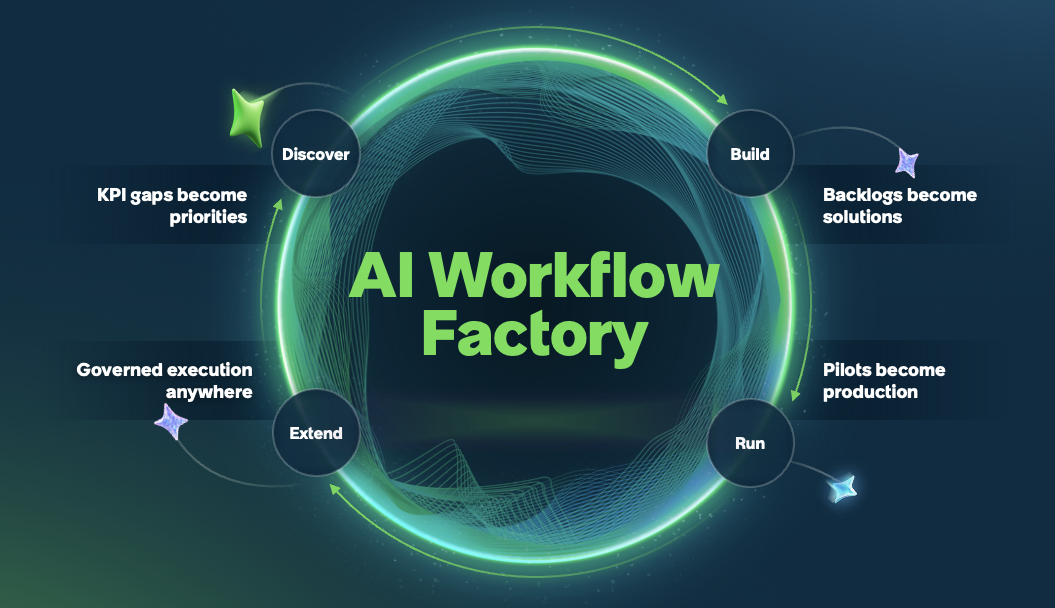
Principal Basil C. Puglisi reads the newest round of agent platforms as a handoff of the improvement cycle itself, and he wants two things settled before a client signs: the number the loop is chasing and the person who can stop it. ServiceNow announced AI Workflow Factory today at World Forum Mumbai, describing it in its October 6 press release as a continuous workflow improvement loop that connects Process Mining, which identifies which business processes should change and ties them to the KPIs business units measure, with Autonomous Engineer and Build Agent for building the changes and App Engine for running them at scale. AI Workflow Factory is globally available now, and Autonomous Engineer is in early access on request.
A day earlier, Cohere released North 2, which adds a redesigned agent harness, reusable agents and automations that can be shared across an organization, and admin controls for cost caps, rate limits, and user quotas. Both vendors are selling the same promise from different ends. ServiceNow starts from the process and the KPI gap, and Cohere starts from the agents and the guardrails around them. Puglisi’s consulting position is that a loop only gets better when the measurement was written before it started and a named human holds binding authority at the points where it changes real work.
Two of his frameworks carry that position. Factics requires that every fact lead to a tactic and every tactic leave evidence, with the KPI defined before the action so the result can fail. Checkpoint-Based Governance puts a named human at defined points in the work, gives that person authority to accept, modify, or reject what happens next, and keeps a record of who decided, on what evidence, and why. A continuous agent loop needs both, because a loop that measures itself against a target it chose afterward will always report progress.
ServiceNow puts the KPI at the front of the agent loop
The press release gives a worked example. A business sets a goal of raising case deflection by 20 percent across several business units. In the older pattern, a team would build a case deflection practice, pilot it in one unit, and then move to the next. Under AI Workflow Factory, ServiceNow says Process Mining shows where cases can be deflected today, the platform builds the workflows, and AI agents roll them out across the business units in tandem while they keep refining the process against the stated outcome, all inside the guardrails set in AI Control Tower.
That sequence matches the Factics order more closely than most vendor pitches do, since the outcome comes first and the build follows it. ServiceNow also says people still set the direction and approve the outcome while AI moves more of the work forward. For a client, the open question sits inside that sentence. Approving an outcome across several business units at once is a large decision, and the press release does not say who approves it, at which stage, or what record that approval leaves. Checkpoint-Based Governance turns that sentence into a design requirement: name the approver for each business unit, set the checkpoint before rollout and again after the first measurement window, and log each decision with its rationale.
Cohere North 2 moves cost and autonomy limits into the admin console
North 2 gives administrators controls a deployment team can write into a plan. North Admin sets roles and permissions, controls which models get used where and by whom, and shows token spend and limits down to the user and agent level, with alert thresholds that can warn teams before a limit is reached. Cohere’s autonomy policies are built so agents take only the actions they are authorized to take and seek human oversight for critical decisions or actions. North deploys on premises, in a private cloud, or fully air gapped, and Cohere lists SOC 2 Type 2, ISO 27001, and ISO 42001 certifications.
Puglisi treats those settings as the place where a governance policy becomes enforceable. A spend cap per agent is a measurable limit, and an autonomy policy that routes critical actions to a person is a checkpoint, provided the organization decides in writing which actions count as critical and who receives them. Cohere’s post says North gives teams the tooling to measure AI ROI, whether the organization tracks adoption or model consumption. Factics adds one step to that claim. Adoption and token spend are inputs, so the business case still needs an outcome measure, such as cycle time or error rate on the workflow the agent took over, set against the baseline before launch.
Kantata turns a delivery standard into a governed agent
Kantata’s Agent Studio announcement from September 22 addresses the same problem from inside professional services. Practice leads, delivery directors, and PMO owners describe a recurring deliverable in plain language, including its format, escalation rules, level of detail, and required outputs, and the platform builds an agent around that standard. Every build and edit is validated before publication so its inputs and outputs are structured correctly, and the published agent can run on a person’s command or from a workflow. Kantata CTO Vikas Nehru put the risk plainly in the release, saying an agent that improvises is a liability where the same deliverable has to hold up in front of a client every time.
A written standard is the part of this release Puglisi would keep for any client, whatever platform they use. The standard tells the checkpoint reviewer what a correct output looks like, so the review compares each output against something written down. Without it, a reviewer approving agent output at volume drifts toward acceptance by default, the failure mode the Checkpoint-Based Governance page describes as passive acceptance.
What an operations lead should settle before the loop goes live
The Checkpoint-Based Governance page gives a usable test for continuous systems. When acceptance rates stay above 95 percent, or reversals stay below 2 percent, across three consecutive cycles, the framework calls for a mandatory audit, since a reviewer who never changes anything may be governing well or may have stopped reading. A loop that improves itself every cycle produces exactly the volume of approvals where that drift appears, so the audit trigger belongs in the deployment plan from the first day.
Puglisi’s pre-launch brief for an agent loop fits on one page. It states the KPI and the current baseline, names the approver at each checkpoint and the evidence that approver will see, sets the spend and autonomy limits in the platform’s own console, and records the date the first result gets read against the baseline. If the loop beats the baseline on that date, it earns the next business unit. If it falls short, the team re-checks the evidence first and changes the tactic second, which is the order Factics prescribes, and the loop waits until a named person decides it should run again.
Sources
- ServiceNow. (2026, October 6). ServiceNow launches AI Workflow Factory to turn workflow improvement into a continuous, agentic AI-powered loop [Press release]. https://newsroom.servicenow.com/press-releases/details/2026/ServiceNow-launches-AI-Workflow-Factory-to-turn-workflow-improvement-into-a-continuous-agentic-AI-powered-loop/default.aspx
- Cohere Team. (2026, October 5). North 2: Enterprise AI without compromises. Cohere. https://cohere.com/blog/introducing-north-2
- Kantata. (2026, September 22). Kantata unveils Agent Studio: AI agents that go beyond automation to compound professional services expertise. https://www.kantata.com/blog/article/kantata-unveils-agent-studio-ai-agents-that-go-beyond-automation-to-compound-professional-services-expertise
Questions readers ask
What is ServiceNow AI Workflow Factory?
AI Workflow Factory is a ServiceNow offering announced on October 6, 2026 that links Process Mining, Autonomous Engineer and Build Agent, and App Engine into a continuous loop. Process Mining finds which processes should change against business unit KPIs, the build tools create the improvements, and App Engine runs them at scale under AI Control Tower governance.
Is AI Workflow Factory available now?
ServiceNow says AI Workflow Factory is globally available as of October 6, 2026. Autonomous Engineer, the unattended coding capability for planning, building, and testing implementation work, is in early access and available on request.
What does Cohere North 2 add for enterprise deployments?
North 2 adds a redesigned agent orchestration harness, shared reusable agents and automations, memory across sessions, and new enterprise connectors. North Admin adds cost controls, rate limits, user quotas, and organization-wide caps, and autonomy policies route critical actions to human oversight. It runs in the cloud, on premises, or air gapped.
What is Kantata Agent Studio?
Agent Studio is a conversational environment in the Kantata Expertise Engine, announced September 22, 2026, that lets professional services leaders describe a recurring deliverable in plain language and turn it into a governed agent. Each build and edit is validated before publication, and the agent can be triggered by a person or by a workflow.
How does Factics apply to a continuous AI workflow loop?
Factics requires a verified fact, a specific tactic, and a KPI defined before the action. For an agent loop, the team writes the target metric and baseline before launch, lets the loop run for a set window, and reads the result against that baseline. If the loop falls short, the evidence is re-checked before the tactic changes.
Where should human checkpoints sit in an agent-run workflow?
Under Checkpoint-Based Governance, a named person with authority to accept, modify, or reject sits before rollout and after the first measurement window, with a record of each decision and its rationale. Acceptance above 95 percent or reversals below 2 percent across three cycles trigger an audit of the review itself.
#AIg
Leave a Reply