Between October 21 and 22, 2026, Kognitos, Pactum and Tipalti released finance and procurement agents with a shared promise. Each agent starts under human approval and takes on more work by itself as the team grows comfortable with it. Tipalti says that “as confidence in the agent grows, users can expand the range of activities it executes autonomously.” None of the three releases says what evidence should count as confidence or what happens to the agent’s track record once nobody is checking its work. For a finance team, each step up in autonomy is a decision about who answers for a payment, and these releases leave room to make that decision on a feeling.
Basil C. Puglisi’s working paper Why Agentic AI Was Always Going to Fail (June 2026) gives the lens. His Named-Human Test asks one question of any system: is there a named human with binding authority to approve, modify or halt the output, whose accountability survives an audit? Autonomy, he argues, adds technical independence without moving a system across that line, because “only a named human does that.” His advice for a client turning these dials follows directly. Treat every expansion of agent autonomy as a promotion, write down the evidence behind it, and keep checking a sample of the agent’s work after it’s promoted.
What Kognitos, Pactum and Tipalti released on October 21 and 22
Tipalti announced AP Agent on October 22. It connects invoice capture, coding, approvals, payments and reconciliation into one workflow, and it draws on vendor history, general ledger data and company policy to make what Tipalti calls context-aware decisions. Finance teams control which activities the agent handles independently and which require human approval. The agent keeps an audit trail, shows field-level reasoning, and applies user corrections to future processing. Tipalti frames the buyer’s question as “how much responsibility they are comfortable giving it.”
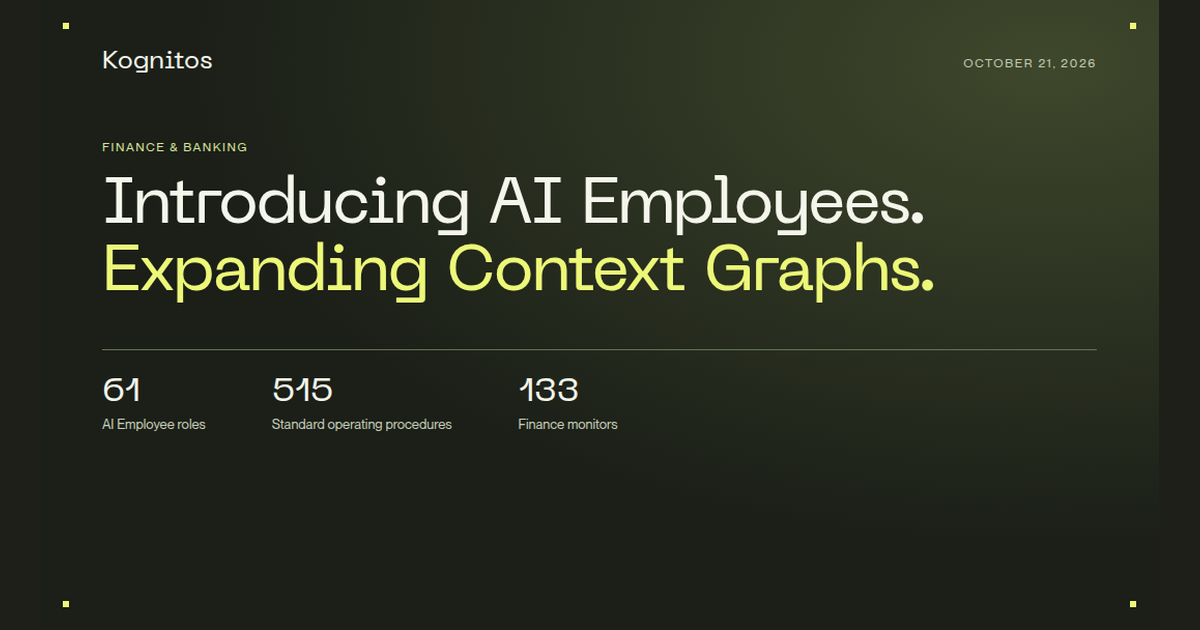
Kognitos launched AI Employees on October 21, now in preview for its customers. The release lists 61 finance and banking roles backed by 515 standard operating procedures, each with a job description and “defined limits on what it can do without human approval.” When a case falls outside the procedure, the run pauses and asks a person. Kognitos says that as approved guidance builds up, “fewer runs need a person, and the team decides, action by action, when an employee may act without asking first.”
The same day, Pactum launched an Intake Agent that turns a plain-language purchase request into a coded requisition, checks it against buying policy and hands it to other Pactum agents for sourcing and negotiation. Co-founder and CEO Kaspar Korjus says procurement teams “can now run indirect procurement with full autonomy while remaining in control and managing the exceptions.” The headline claims a 90% cut in purchase request cycle time, but the release text gives no baseline or method for that figure, so it reads as a vendor claim.
Each vendor leaves the meaning of confidence to the customer
The three products share a sound design choice. Each one lets the customer set the line between what the agent does alone and what waits for a person, and Kognitos goes further by drawing that line one action at a time. That’s a real improvement over agents that arrive with a fixed level of independence.
What none of them supplies is a definition of the evidence that should move the line. Tipalti ties expansion to growing confidence, Kognitos to accumulated guidance and Pactum to rules set once and applied “to every request, whatever its value.” A controller who widens AP Agent’s authority after a quiet month has made a judgment, and the audit trail will show what the agent did afterward without showing why anyone allowed it. Kognitos’s own release cites research on 15 models across 18 months of releases that found accuracy improved while reliability “barely changed.” That finding gives a client reason to ask for more than one good stretch before granting more room.
Promotion cuts off the corrections that justified it
A second problem sits inside the learning loop. Tipalti’s agent improves by applying user corrections, and Kognitos turns approved answers into guidance. Both depend on people reviewing the agent’s work and correcting it. Once an action moves to autonomous, those reviews stop for that action, and so do the corrections. The accuracy record that earned the promotion freezes at its last supervised value, while invoices, vendors and policies keep changing underneath it.
In practice, the evidence for an agent’s autonomy is strongest on the day the autonomy is granted and weakens every week after. A team that wants to know whether the promotion still holds has to keep producing that evidence on purpose, because the workflow will no longer produce it by default.
How Puglisi would govern autonomy expansion for a finance client
The paper’s high-velocity carve-out shows where the human belongs once per-transaction review ends. When outputs move too fast for a person to approve each one, the checkpoint moves upstream, and a named human signs the policy that authorizes that class of outputs. For a finance agent, that policy is the promotion record. Under Puglisi’s Checkpoint-Based Governance (CBG), one named person accepts, modifies or rejects each proposed step up, and the decision is recorded with its date.
A usable promotion record is short. It names the action class, such as coding invoices under a set amount for existing vendors. It states the evidence window, meaning a fixed number of supervised runs and the override and exception rates seen across them. It sets a value ceiling, since Pactum’s “whatever its value” is a choice a client should make on purpose, and it names the demotion trigger that returns the action to human approval.
The record also commits the team to a standing sample. A fixed share of autonomous runs, chosen at random, still goes to a reviewer after promotion, and the client sets that share by risk. Reviewers grade those runs the way they graded supervised ones. If the sampled error rate rises past the trigger, the action goes back to approval automatically, and the named approver decides whether to promote it again. Puglisi’s distinction holds here too. Vendor monitors and QA checks that flag anomalies are Responsible AI, a machine checking a machine with no human review, and they’re worth running. Signing the promotion and owning the demotion are AI Governance.
Two measures tell a client whether this works. The first compares the sampled error rate on autonomous runs, month by month, with the override rate the same action showed before promotion, so drift shows up as a widening gap. The second counts the share of autonomous action classes that carry a signed promotion record, and the target for that share is all of them.
What to watch as finance agents take on more of the ledger
These launches move the main governance decision in accounts payable and procurement from approving transactions to approving the agent’s authority. That decision now happens inside product settings, and none of the three releases describes a record of who widened the agent’s authority, when, or on what evidence.
The open problem is the threshold itself. None of the three releases says how many supervised runs, or what override rate, should justify letting a finance agent act alone, and Kognitos’s cited research suggests accuracy alone won’t settle it. Watch whether Tipalti or Kognitos add a promotion history to their audit trails as these products mature, and whether Pactum publishes the method behind its cycle-time figure. Watch, too, whether external auditors start asking for the evidence behind an agent’s autonomy next to the log of its actions. The log can tell an auditor what happened, and only a signed promotion record can tell them who allowed it.
Sources
- Kognitos. (2026, October 21). Kognitos launches AI Employees and expands Context Graphs for finance and banking [Press release]. https://www.kognitos.com/news/kognitos-launches-ai-employees-context-graphs-finance-banking/
- Pactum. (2026, October 21). Pactum launches Intake Agent, cutting purchase request cycle time by 90% [Press release]. PR Newswire. https://www.prnewswire.com/news-releases/pactum-launches-intake-agent-cutting-purchase-request-cycle-time-by-90-302915539.html
- Puglisi, B. C. (2026, June 4). Why agentic AI was always going to fail. basilpuglisi.com. https://basilpuglisi.com/why-agentic-ai-was-always-going-to-fail/
- Tipalti. (2026, October 22). Tipalti advances agentic AI with new AP Agent to bring greater autonomy to finance operations [Press release]. Business Wire. https://www.businesswire.com/news/home/20261022600973/en/Tipalti-Advances-Agentic-AI-with-New-AP-Agent-to-Bring-Greater-Autonomy-to-Finance-Operations
Questions readers ask
What did Tipalti announce on October 22, 2026?
Tipalti announced AP Agent, an AI agent that runs the accounts payable process from invoice capture through coding, approvals, payments and reconciliation. Finance teams choose which activities it handles alone and which need human approval, and Tipalti says users can expand its autonomous range as confidence grows. It also added MCP access to Tipalti data.
What are Kognitos AI Employees?
Kognitos AI Employees, launched in preview on October 21, 2026, are finance and banking agents assigned to 61 defined roles and 515 standard operating procedures. Each role has set limits on what it may do without human approval, pauses to ask a person when a case falls outside its procedure, and keeps a run journal an auditor can read.
What is a promotion record for an AI agent?
A promotion record is a short signed document that authorizes an agent to perform one class of actions without per-transaction approval. It names the action class, the supervised evidence behind the decision, a value ceiling and the trigger that returns the action to human approval. One named person accepts, modifies or rejects it, and the date is recorded.
Why keep reviewing an agent’s work after it becomes autonomous?
Once an action runs without approval, the human corrections that measured the agent’s accuracy stop, so its record freezes at the last supervised value. A random sample of autonomous runs sent to a reviewer keeps that evidence current. If the sampled error rate rises past the agreed trigger, the action returns to human approval until the approver decides again.
What is the Named-Human Test?
The Named-Human Test, from Basil C. Puglisi’s June 2026 paper, asks whether a named human holds binding authority to approve, modify or halt a system’s output and answers for it in an audit. If yes, the system sits under AI Governance however autonomous it is. If no, it is Responsible AI, automation with no named human bound to the output.
#AIg
Leave a Reply