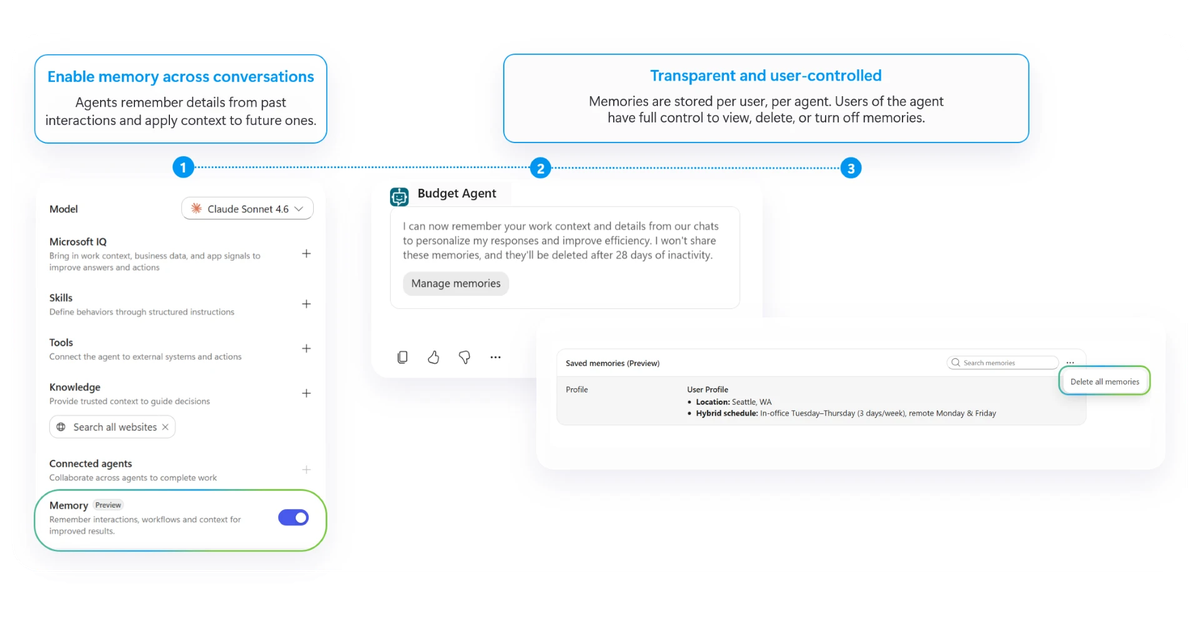
On October 15, 2026, Microsoft announced two Copilot Studio features that change where a company’s working rules live. Agent accounts let an agent work in Microsoft 365 under its own credentials, and business process memory lets it carry users’ preferences and process context into each new cycle. Microsoft’s post states the effect in one line: “Any idiosyncrasy of the business process that one person raises to the agent then becomes a shared resource for everyone else to benefit from.” For a finance or HR team, that sentence describes a workflow change that can happen inside a chat, with no change request and no sign-off.
Principal Basil C. Puglisi addressed this kind of drift in Narrative Is Not Custody: Why AI Compliance Needs Traversable Rules, where Checkpoint-Based Governance (CBG) places a human checkpoint before the system runs. At that checkpoint, a person approves what the system is allowed to treat as the rule. Agent memory opens a new path for rules to enter a workflow. Puglisi’s advice to clients this quarter is to treat a remembered exception as a proposed rule that needs approval before anyone else’s work depends on it.
What Microsoft, Zendesk, and SAP Signavio shipped for workflow agents between October 15 and 20
Microsoft’s post, written by Copilot Studio vice president Jason Moore, describes managed agents “that belong to the organization, persist beyond any one individual’s role or tenure.” With agent accounts, people can @mention an agent in Word, Excel, and PowerPoint comments or hand it tasks through Teams and email. Microsoft says the accounts let work “be attributed to the agents, while process owners retain control over its scope.” Triggers in the GitHub Copilot harness can start an agent’s cycle from an email or a set cadence with no prompt. Microsoft lists additional access policies along with quality, cost management, and lifecycle controls as planned “in the coming months,” and the features are rolling out through its Frontier program.
Zendesk followed on October 19 with Employee Service AI Agents and Advanced Action Flows, which handle multi-step employee requests such as access approvals, laptop lifecycle management, and badge access. IT admins describe an automation in plain language, and the agent coordinates the work across back-end systems from Slack or Microsoft Teams. Zendesk reports that 300 early-access customers ran 6 million workflow executions in five weeks, and it estimates 500,000 hours of manual work saved. The features are in open early access, with general availability expected in the coming weeks.
On October 20, SAP Signavio’s October release added a beta for agent-led process mining exposed through MCP, where the agent runs the full analysis workflow “without manual intervention.” Its Process Data Modeling Agent, also in beta, takes the opposite approach. Users review and approve the proposed objects, relationships, and events “before any pipeline is created,” and the Initiative Enricher shows each AI suggestion for individual review so “nothing is added without confirmation.”
Why agent memory can turn one person’s exception into a process rule
Business process memory is useful, and the budget example in Microsoft’s post shows why. A finance lead builds an agent that gathers planning records each Tuesday, asks budget owners about unexplained changes, and escalates decisions to the finance team, which keeps authority over allocations and spending. Across review cycles the agent carries forward review requirements and unresolved questions, so the team spends less time reconstructing what happened.
The same mechanism has a second effect. Suppose one budget owner tells the agent that a certain vendor’s overruns don’t need an explanation. If the agent stores that as process context, the exemption reaches every later review, and nobody with authority over the budget process ever accepted it. Microsoft says makers guide how retained context is used and decide “which business records and policies are authoritative.” That decision is where control sits. The memory diagram in Microsoft’s post also shows that users can view, delete, or turn off their memories. Those controls help an individual user, and the owner of the workflow still has to find out which remembered items now act as policy.
Puglisi’s article separates Responsible AI from AI Governance, and that split decides how a client should treat what an agent remembers. In Responsible AI, the machine checks the machine. In AI Governance, a named human holds checkpoint authority to accept, modify, or reject. CBG, as that article lays it out, puts one checkpoint before the run, where the governor approves the rules the system will treat as binding. A second checkpoint after the run lets the governor validate the output before it leaves the building. Agent memory works on the first checkpoint because it can change the rules between runs. A workflow that passed review in September can carry different working rules in November with no new approval on file.
Where factory-quality memory fits and where it needs a human checkpoint
In Agents or Agency: Transparency Is Success, Puglisi calls Responsible AI the factory and AI Governance the handmade product, and he treats both as legitimate choices. Factory quality fits “when stakes allow process controls to suffice, when outputs are reversible.” A remembered meeting time or report format fits that description. A remembered exemption from a budget explanation or a shortcut on access approvals does not, because each one changes who decides.
SAP Signavio’s data modeling agent shows what the handmade lane looks like in a shipping product, since a person approves the agent’s proposal before the pipeline exists. Zendesk’s Advanced Action Flows are administrator-built workflows that “carry out tasks in line with organizational policies and goals,” which keeps the rule in a place an admin wrote and can audit. Memory sits in neither design by default, so each client has to decide which lane it belongs in.
What a client should set up when workflow agents start remembering
Start with an inventory. List every agent with memory turned on and the processes it touches, then mark the ones that can change money, system access, or employment status. Microsoft’s makers already decide which records and policies are authoritative, so put that list in writing and give it a version number.
Next, sort remembered items into two classes. Preferences, such as report format or meeting timing, can stay in the factory lane with periodic sampling. Anything that adds an exception or changes an approval path is a proposed rule, and the process owner accepts, modifies, or rejects it before the agent applies it to anyone else’s work. Log each decision with the date and the reason.
Then measure savings on the client’s own workflows, with a clock the client controls. Zendesk’s footnote says its 500,000-hour estimate rests on “a conservative industry benchmark of five minutes saved per workflow execution,” and 6 million executions at five minutes each comes to that figure. The number multiplies volume by an assumption, so it can’t yet tell a client anything about reopened requests or the time people spend checking the agent’s work. Time a sample of requests before and after deployment, and count the ones that came back.
Two numbers belong in the monthly operations review. The first is the share of rule-type memory entries that a process owner approved before reuse, with a target of 100 percent in finance and HR. The second is the count of remembered items reversed after review, which shows how often the agent learned something nobody meant to teach it.
What to watch as workflow agents gain accounts and memory
Agent accounts give each agent its own identity in the record, and Microsoft says that makes it clearer which actions agents took and which people took. Memory moves part of the workflow definition into a store that changes with use, so an agent’s identity can stay constant while its working rules shift. The vendor material published this week doesn’t show a change log for remembered rules that a process owner signs, and that gap is the open problem in these releases.
Two signals deserve attention. Watch whether the access policies and lifecycle controls Microsoft plans for the coming months include review of shared memory, and whether Zendesk publishes measured time savings once general availability arrives. Until a vendor ships memory review, the approval record for remembered rules has to live in the client’s own process documentation, where an auditor can read it next to the rule it changed.
Sources
- Moore, J. (2026, October 15). Delegate shared business processes to agents that are more persistent and proactive with Microsoft Copilot Studio. Microsoft Copilot Blog. https://www.microsoft.com/en-us/copilot/blog/copilot-studio/delegate-shared-business-processes-to-agents-that-are-more-persistent-and-proactive-with-microsoft-copilot-studio/
- Puglisi, B. C. (2026a, October 11). Narrative is not custody: Why AI compliance needs traversable rules. basilpuglisi.com. https://basilpuglisi.com/ai-compliance-traversable-rules/
- Puglisi, B. C. (2026b, October 16). Agents or agency: Transparency is success. basilpuglisi.com. https://basilpuglisi.com/agents-agency-transparency/
- SAP Signavio. (2026, October 20). OUT NOW: SAP Signavio October 2026 release: You direct, AI executes. SAP Signavio. https://www.signavio.com/post/october-2026-product-release-update/
- Zendesk. (2026, October 19). Zendesk introduces Employee Service AI Agents to take employee requests from question to outcome [Press release]. Zendesk Newsroom. https://www.zendesk.com/newsroom/articles/zendesk-introduces-employee-service-ai-agents-to-take-employee-requests-from-question-to-outcome/
Questions readers ask
What did Microsoft announce for Copilot Studio agents on October 15, 2026?
Microsoft announced agent accounts, which let Copilot Studio agents work in Microsoft 365 under their own credentials and scoped permissions, and business process memory, which carries users’ preferences and process context into each new cycle. Triggers can also start an agent from an email or a set cadence, and the features are rolling out through the Frontier program.
Why can AI agent memory change a business process?
Microsoft says any process idiosyncrasy one person raises to the agent becomes a shared resource for everyone else. When that remembered item is an exception or a changed approval step, it reaches every later cycle. Basil C. Puglisi treats such an item as a proposed rule that a process owner accepts, modifies, or rejects before the agent reuses it.
How did Zendesk calculate 500,000 hours saved by its AI agents?
Zendesk reports that 300 early-access customers ran 6 million workflow executions with Advanced Action Flows in five weeks. Its footnote says the 500,000-hour figure uses a benchmark of five minutes saved per execution. The estimate multiplies volume by an assumption, so clients should time their own requests and count reopened ones before citing savings.
What is Checkpoint-Based Governance?
Checkpoint-Based Governance (CBG) is Basil C. Puglisi’s framework for placing human authority at defined points in an AI workflow. Before a run, a human governor approves the scope and the rules the system may treat as binding. After the run, the governor validates the output and accepts, modifies, or rejects it before it leaves the organization.
Which agent memories can stay automated and which need human approval?
Preferences such as report format or meeting timing fit factory quality, where outputs are reversible and machine checks with periodic sampling suffice. Remembered items that add an exception or change an approval path in finance or HR workflows need a human checkpoint, with each decision logged by date and reason before the agent reuses them.
#AIg
Leave a Reply