Businesses are giving AI agents names, titles and seats in team structures, and far fewer have assigned a human to manage them or track whether they’re accurate. Two surveys released on November 12, 2026 point at the same gap. Both are self-reported, and both come from vendors, so the figures below belong to Genpact and Vida and carry their limits.
Basil C. Puglisi reads the gap as a case of workforce language arriving before workforce management. Puglisi’s October post, Agents or Agency: Transparency Is Success, describes two honest choices for any organization that puts AI to work. Agents can carry the work with machines checking machines, or a named human can hold authority at defined checkpoints. His advice for operations leaders follows from that choice.
Agents reached production before operating models changed
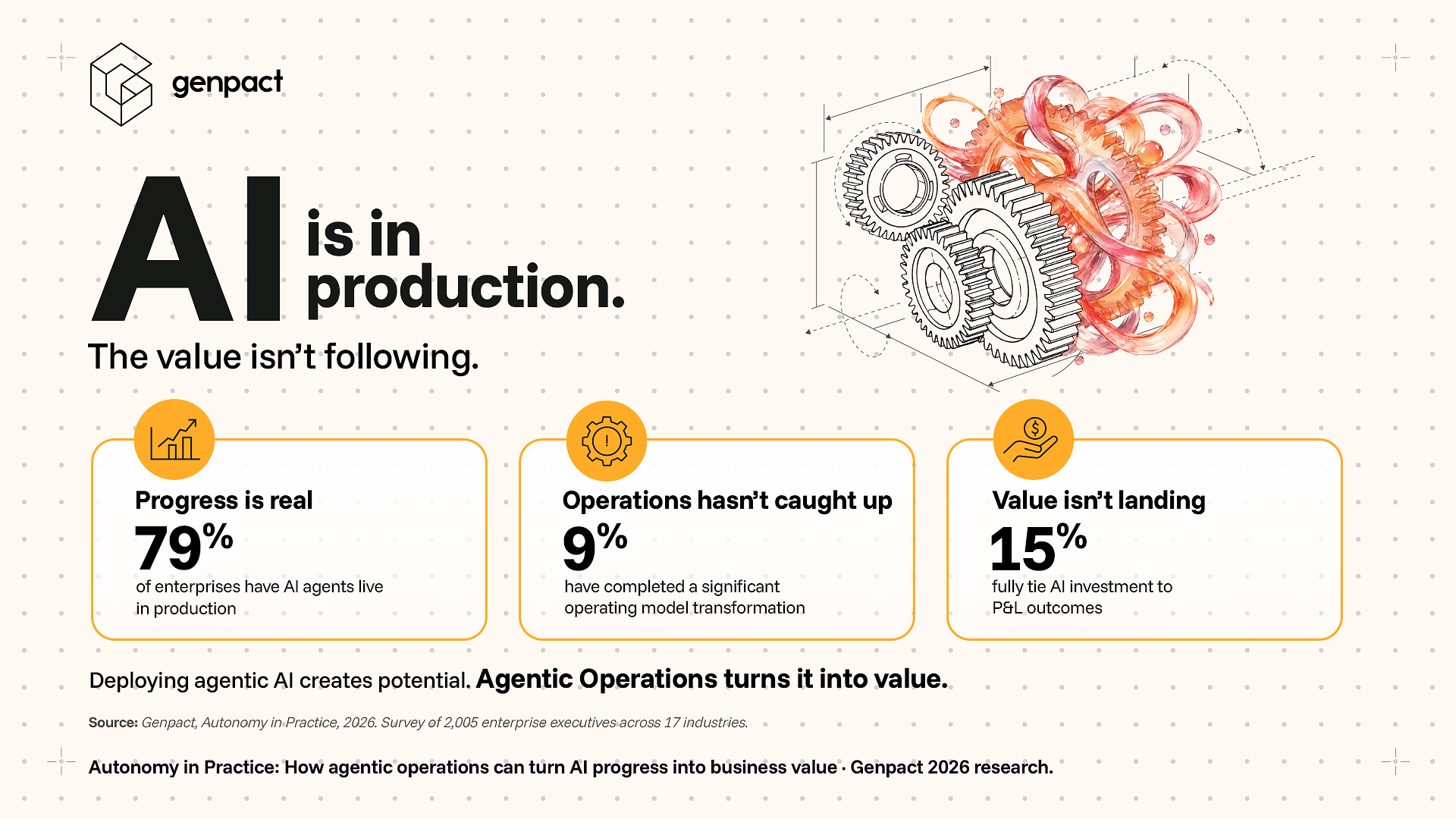
Genpact’s report, Autonomy in Practice, surveyed more than 2,000 senior executives at companies with annual revenue from $1 billion to more than $50 billion. Genpact sells agentic operations services. In its survey, 79% of enterprises have agents in production. Only 20% use them broadly and consistently across functions, and only 9% have completed significant operating model transformation.
The same release says AI now leads or fully runs 40% of decisions. Humans still decide or audit in at least 87% of cases at every decision stage. Genpact’s own summary is that agents reached production faster than enterprises redesigned how they operate. Its description of leading firms includes governing and securing agents throughout their lifecycle, not only at deployment.
Vida’s survey shows the naming side of the story. Vida sells an AI agent platform, and it polled 215 U.S. business decision-makers from October 22 to 28, 2026. Of those respondents, 63% give their agents a name, 60% assign a formal title, and 55% include agents in team structures or workflows. Only 16% consider agents part of the workforce, and only 41% say they assign a human to manage or oversee them.
A job title comes with a manager, and an agent’s title comes with one only if someone writes it
A human title in an operations team usually arrives with a manager, a written job description, a performance review and someone who can stop the work. Puglisi’s observation is that an agent’s name and title carry none of those by themselves. They are org-chart language. A reporting line means something only when a person has actually accepted it.
The Agents or Agency post puts the stakes plainly. It says the factory model of agents run by machines has a legitimate place. That model still has an owner, because the factory can run without a hand on each output but can’t run without someone who answers for it. It also says governance doesn’t require a person to review every output. It requires defined thresholds where human authority activates before consequences become irreversible.
That is the design Puglisi would hand to a client’s leadership team. Checkpoint-Based Governance (CBG), his framework for naming a human with binding authority at defined points, frames the manager’s job as one decision. The manager accepts, modifies or rejects what the agent produces or is allowed to do. A manager who only watches a dashboard is present without holding that authority.
Accuracy dashboards check the machine, and a person still decides
Vida’s release shows where measurement lags. Among respondents with digital employees deployed, 75% say they’ve defined KPIs, but only 40% track performance against them. The most common metric is tasks successfully completed, at 76%. Meanwhile, 72% name quality or reliability as their top concern for agents, and only 12% track accuracy or error rate today. The release doesn’t state the base for every figure, so readers should treat the comparison as directional.
Under Puglisi’s definitions, an accuracy dashboard, an automated evaluation and an error-rate monitor are machine checking machine. That is Responsible AI, and it’s useful work. A monitor can tell a team that an agent’s error rate rose last Tuesday, and it can trigger a preset action. It can’t own the call on whether to accept the output, narrow the agent’s scope or stop the work. In his definitions, AI Governance begins where a named human holds that decision.
Five steps for an operations leadership team
These steps are Puglisi’s advice to a client, built on his position that a title needs a manager behind it.
- Inventory every agent that acts in a workflow. Record its owner, its scope and the permissions it holds in each system. If an agent isn’t in the inventory, nobody can show from the record who manages it or what it’s allowed to touch.
- Write a job description for each agent. List the tasks it may do and the tasks it may not do. Add the triggers that send a case to a person.
- Choose KPIs that include accuracy. A count of tasks completed measures activity, not quality. Add an error rate or accuracy measure so the review has something to judge quality against.
- Name one human manager and a deputy per agent. The manager signs accept, modify or reject at go-live and at every widening of scope or permissions. A monthly performance review against the written KPIs carries the same signature. Each one is recorded.
- Hold the workforce label until the record exists. An agent joins the workforce, in documents and on slides, once it has a manager on record.
Four measures show whether the management exists
Operations leaders can track the following on a single page each month. Baseline them first, then watch the direction.
- Manager coverage: the share of production agents with a named manager and deputy on record.
- Accuracy tracking: the share of production agents with an accuracy or error-rate measure in their KPIs.
- Change control: the share of scope or permission changes that carry a signed accept, modify or reject record.
- Decision speed: the days between a flagged error and the manager’s recorded decision.
The limits deserve plain statement. Both surveys are self-reported vendor research. Vida sells AI agents and polled 215 people. Its release reports a full-sample margin of error of about ±6.7 percentage points at 95% confidence, so subgroup figures carry more uncertainty. Genpact surveyed companies with revenue of $1 billion and up, and it reports rounded percentages. The two populations differ, so the figures shouldn’t be merged into one benchmark. Puglisi’s framework is also a proposal that other practitioners can test, challenge or replace.
A seat on the org chart goes to the agent whose manager answers for it
Genpact reports that 92% of respondents with agents in production kept their human workforce the same size or grew it. Agents are scaling beside people, and people are the ones who will be asked what went wrong. When a customer or an auditor asks who was responsible for an agent’s output, the answer has to be a name that appears on the org chart.
That is the test Puglisi applies to the workforce language. An agent earns a seat when someone already seated answers for it. Until then, the title is a label on software. The surveys leave a harder question open, and it concerns capacity. How many agents can one person answer for while still holding real accept, modify or reject authority? Operations leaders can watch that number next, because it decides whether the manager on record is real.
Sources
- Genpact. (2026, November 12). 79% of enterprises report AI agents in production, but only 15% have fully tied AI investment to P&L outcomes [Press release]. https://media.genpact.com/2026-11-12-79-of-Enterprises-Report-AI-Agents-in-Production,-but-Only-15-Have-Fully-Tied-AI-Investment-to-P-L-Outcomes
- Puglisi, B. C. (2026, October 16). Agents or agency: Transparency is success. basilpuglisi.com. https://basilpuglisi.com/agents-agency-transparency/
- Vida Global Inc. (2026, November 12). New Vida survey finds businesses racing to build an AI agent workforce, but traditional management practices still catching up [Press release]. Business Wire. https://www.businesswire.com/news/home/20261112147669/en/New-Vida-Survey-Finds-Businesses-Racing-to-Build-an-AI-Agent-Workforce-but-Traditional-Management-Practices-Still-Catching-Up
Questions readers ask
What does it mean to give an AI agent a named human manager?
It means one person is recorded as answerable for that agent, with a deputy for absences. The manager holds authority to accept, modify or reject the agent’s launch, its scope changes and its monthly performance results. The record shows who decided and when, which a job title alone can’t show.
Why aren’t accuracy dashboards enough to govern an AI agent?
A dashboard, an automated evaluation or an error-rate monitor is a machine checking a machine. It can flag drift or trigger a preset action, but it doesn’t answer for the result. Basil C. Puglisi calls that Responsible AI. AI Governance adds a named human who can accept, modify or reject at defined checkpoints, and that decision is recorded.
What belongs in an AI agent’s job description?
The description lists tasks the agent may perform, tasks it may not perform, and the triggers that route a case to a person. It also names the systems and permissions the agent holds, its manager and deputy, and the written KPIs for review, including an accuracy or error-rate measure alongside tasks completed.
How often should a manager review an agent?
Puglisi’s advice is a signed decision at go-live, a signed decision at every widening of scope or permissions, and a monthly review against the written KPIs. Each decision is accept, modify or reject, and each is recorded. Teams can adjust the cadence for risk, but the record should stay.
What did the Genpact and Vida surveys find about managing agents?
Genpact reports 79% of surveyed enterprises have agents in production and 9% have completed significant operating model transformation. Vida reports 63% name agents and 41% assign a human to oversee them. Both are self-reported vendor surveys of different populations, and Vida’s sample was 215 U.S. decision-makers.
#AIg
Leave a Reply