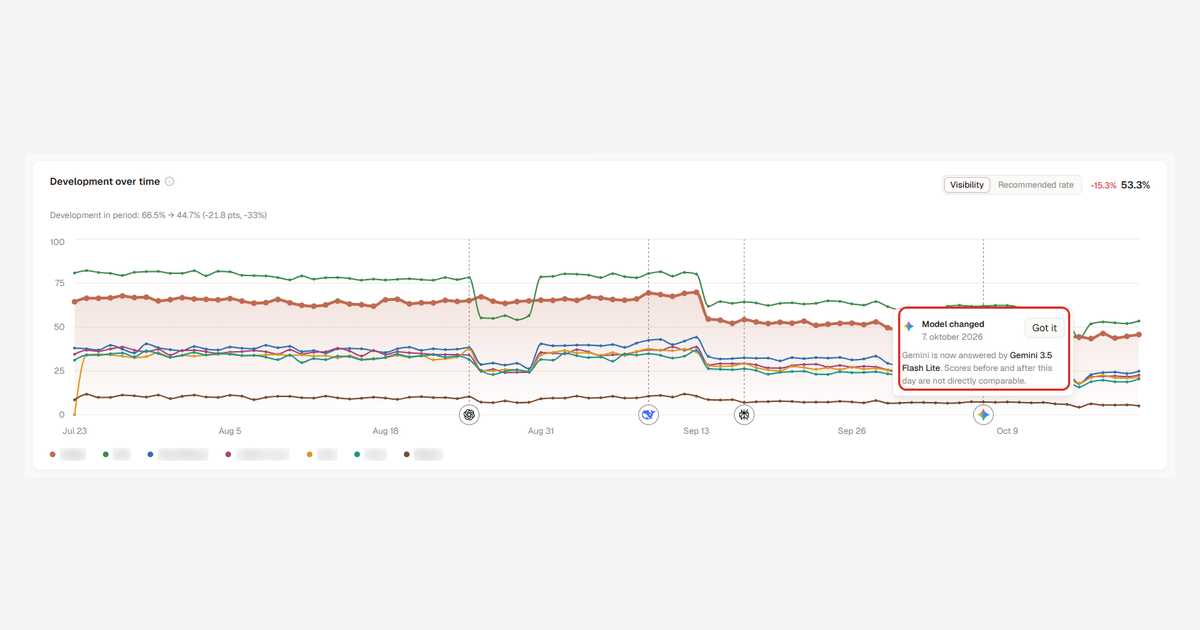
On October 19, 2026, the AI visibility vendor 3RD published The state of AI visibility, Q4 2026. It draws on 732,000 AI answers tracked for its customer brands between September 19 and October 18. The median brand’s daily visibility moved 12.5 points between its best and worst day in that month, with no change to its prompts. Across the 60 brands it checked more deeply, the median brand was mentioned in 19.8% of answers and recommended over the alternatives in only 0.2%. For a client who gets a monthly AI visibility number from an agency, a reported “drop” can be ordinary noise. A healthy mention rate can hide a brand that loses the buyer who asks which product to pick.
Principal Basil C. Puglisi set out a measurement model for this problem in AI Visibility: Be the Human Voice AI Can Find, where he names the discipline AI Visibility Governance. His model measures presence, accuracy, and downstream value together, and it treats a citation as success only when the citation is accurate. Read against that model, this month’s AI visibility benchmarks measure presence in detail and leaves accuracy almost untouched. His advice for clients is to add the missing accuracy column before any budget moves on these scores.
What three October AI visibility reports measured
3RD’s core sample covers 111 brands with a stable daily series, drawn from 51 customer organizations. Its tracking spans up to 11 assistants, including ChatGPT, Gemini, Perplexity, Claude, Copilot, Google AI Overviews and AI Mode. The authors say the sample leans Nordic and that agencies run some of the brands. They call the data observational and say none of it comes from a controlled experiment. Customers choose their own prompts and assistants, and 3RD sells the tracking software, so the figures describe its customer base.
Within those limits, the findings give a marketing team useful priorities. Across 100 brands and 5.9 million citations, a median of 6.8% of the sources AI cited in a brand’s category pointed to the brand’s own domains. For 41 of those 100 brands, AI cited competitors’ websites more often than the brand’s own site. Crawlability scored a median 99 out of 100, while authority or content quality was the weakest driver for 42 of 54 brands. That tells a client most of the gap sits on other people’s pages.
The GEO agency Archipel released its AI Visibility Observatory, October 2026 edition on October 11. It covers 406,626 answers to more than 1,700 buying questions collected from July 12 to October 11. Rankings and comparison pages made up 29.9% of all cited sources, and 88.1% for Claude. Google AI Overviews appeared on 86.7% of tracked buying searches in October, up from 56.3% in July. The brand cited first changed from one week to the next in 63.3% of cases. Most of Archipel’s questions are in French and concern France, and the agency sells GEO audits, so a U.S. client should treat these figures as directional.
MarketScale’s State of GEO snapshot, last updated October 19, covers its tracked B2B projects across five engines. It reports an unweighted average mention rate of 24.06% and a citation rate of 19.80%. MarketScale adds a caution most dashboards leave out: “Mentions and citations do not by themselves measure leads or revenue.”
Each vendor counts a different thing and calls it visibility
Put the three reports side by side and the word “visibility” changes meaning from vendor to vendor. 3RD computes it as the share of AI answers that mention the brand, averaged across prompts. It counts a recommendation only when an answer picks the brand over the alternatives. MarketScale reports mentions and citations as separate rates and warns that their ratio isn’t a conversion percentage, while Archipel classifies the type of page each engine cites. A CMO comparing an agency’s report with an in-house tool may be comparing two different quantities that happen to share a label.
Puglisi’s advice to clients starts with the definition. Before the first report lands, the team should state in plain language what counts as a mention and what counts as a recommendation. The same note should list which assistants are tracked separately and which prompts stay fixed between reporting windows. 3RD’s report explains why a blended score fails: “We rank second” can mean first on Gemini and absent on ChatGPT. For 62% of the brands it checked, a different competitor led on different assistants.
Why accuracy belongs on the AI visibility scorecard
The clearest case for an accuracy column comes from research published October 13 in MIT Sloan Management Review. Its authors are Shahper Richter, Alla Lvovich, Wietske Van Osch, and Alex Richter. They describe a New Zealand investment platform, given the pseudonym Stakewise, whose ChatGPT referral traffic reached roughly 700 sessions a month by mid-2025. Those visitors bounced less and viewed more pages than other referral visitors did. The site also performed strongly on conventional SEO measures.
When the team queried ChatGPT with the questions real customers asked, the answers were “confident, fluent, and frequently wrong.” One widely repeated answer said the platform offered five funds in its KiwiSaver product when it actually offered seven. Other answers mischaracterized fees and described a protective safeguard as restrictive. Every one of those answers would count as a mention on a visibility dashboard.
Puglisi’s post gives clients the vocabulary for this gap. It lists citation precision, misattribution rate, and correction cycle time among the KPIs a mature program tracks. He also draws a line that matters for tooling. A tracker that scores AI answers by machine is Responsible AI in his definition, a machine checking a machine with no human review, and it works well for presence. Deciding that an answer is wrong and choosing which page to fix is AI Governance. Under his Checkpoint-Based Governance (CBG) work, a named person who knows the product holds that checkpoint, with authority to accept, modify, or reject the correction plan.
How Puglisi would build a client’s AI visibility scorecard with Factics
Puglisi’s Factics method holds that every fact must lead to a tactic and every tactic must leave evidence, and that rule turns the October data into a working plan. The facts come from the reports above. Owned pages are a small share of what AI cites, ranking and comparison pages carry heavy weight, and daily scores swing without any change to the brand’s content.
The tactics follow from those facts. 3RD found the 10 most-cited pages on a brand’s site took a median 57% of that site’s citations. So the first job is keeping those pages accurate and current, then linking new pages from them. The second job is outreach to the third-party lists and comparison pages that already answer the client’s must-win questions and name competitors without naming the client. Crawl access needs one check, because it scored highest of 3RD’s five drivers, with a median of 99.
The KPIs should match what the client is trying to win. For a set of must-win buyer questions, track the recommended rate against named competitors on the same prompts. Add the count of factual errors in AI answers about the client and the days it takes to correct each error at the source. 3RD’s guidance is to judge movement on 30-day windows and to treat moves under about 5 points as noise unless they hold for weeks.
3RD also compared 117 completed content tasks against untouched prompts. It found 44% stayed within 5 points, and the median relative change was zero. A client who sees that number should expect many changes to show no clear effect for a while, and the reporting cadence should allow for it.
Downstream value closes the loop, and it’s where MarketScale’s caution applies. Branded search and qualified leads from AI referral sessions belong in the same report. A mention that never reaches a buyer’s shortlist hasn’t earned a budget line yet.
What to watch as AI visibility reporting matures
AI visibility is turning into a line item in marketing budgets. The reports that justify it measure presence with growing precision and leave accuracy to whoever asks. The Stakewise case shows why that gap costs money, since the channel looked healthy on traffic measures while ChatGPT gave buyers the wrong fund count during their comparison.
The open problem is scale. None of the three October reports publishes a factual accuracy rate, and checking whether an answer is right still depends on a person who knows the product and its fine print. Puglisi’s June post notes that Bing exposes AI citation measures such as Citation Share more directly than Google Search Console does. Watch whether Google adds comparable citation reporting for AI Mode and AI Overviews, and whether the next round of vendor benchmarks puts an error rate next to the mention rate. Until one of them does, the error log a client’s own team keeps is the only accuracy measure in the report.
Sources
- Archipel. (2026, October 11). AI Visibility Observatory, October 2026 edition: Six findings. Archipel Marketing. https://www.archipelmarketing.com/en/observatory/editions/2026-10
- MarketScale. (2026, October 19). The state of GEO: The state of AI visibility for B2B companies. MarketScale Research. https://www.marketscale.com/state-of-geo-ai-visibility
- Puglisi, B. C. (2026, June 25). AI visibility: Be the human voice AI can find. basilpuglisi.com. https://basilpuglisi.com/ai-visibility-be-the-human-voice-ai-can-find/
- Puglisi, B. C. (2026, September 2). Factics: The method behind valuable content and trusted AI. basilpuglisi.com. https://basilpuglisi.com/factics/
- Richter, S., Lvovich, A., Van Osch, W., & Richter, A. (2026, October 13). The new rules of brand visibility in AI search. MIT Sloan Management Review. https://sloanreview.mit.edu/article/the-new-rules-of-brand-visibility-in-ai-search/
- Windeløv, M. (2026, October 19). The state of AI visibility, Q4 2026: What we see across 111 brands and 732,000 AI answers. 3RD. https://www.get3rd.com/blog/state-of-ai-visibility-2026
Questions readers ask
What did the 3RD State of AI Visibility Q4 2026 report find?
Published October 19, 2026, the report draws on 732,000 AI answers for 3RD customer brands from September 19 to October 18. The median brand’s daily visibility swung 12.5 points in a month with no prompt changes, and the median brand was mentioned in 19.8% of answers but recommended in 0.2%. The sample leans Nordic and is observational.
Why does a brand’s AI visibility score change from day to day?
AI assistants give different answers to the same question over time, and model updates shift results further. 3RD found 69% of brands had at least one day more than 5 points off their 30-day average, and smaller prompt sets were noisier. Archipel found the first-cited brand changed week to week in 63.3% of cases.
What is the difference between a mention and a recommendation in AI answers?
A mention means the brand’s name appears in an AI answer. In 3RD’s strict definition, a recommendation counts only when the answer picks the brand over the alternatives. The median brand in its sample was mentioned in 19.8% of answers and recommended in 0.2%, so mention rate alone overstates how often AI steers buyers toward a brand.
What is AI Visibility Governance?
AI Visibility Governance is Basil C. Puglisi’s term for making an organization’s knowledge findable, retrievable, citable, accurate, and accountable inside AI-mediated answers. His model measures presence, accuracy, and downstream value together, treats a citation as success only when it is accurate, and assigns a named human owner to each of its five functions, from crawler access to correction.
What should a marketing team measure for AI search visibility?
Track recommended rate against named competitors on fixed must-win prompts, with each assistant reported on its own. Add a count of factual errors in AI answers about the brand and the days needed to correct each one at the source. Read trends over 30-day windows, and connect results to branded search, AI referral sessions, and qualified leads.
#AIg
Leave a Reply