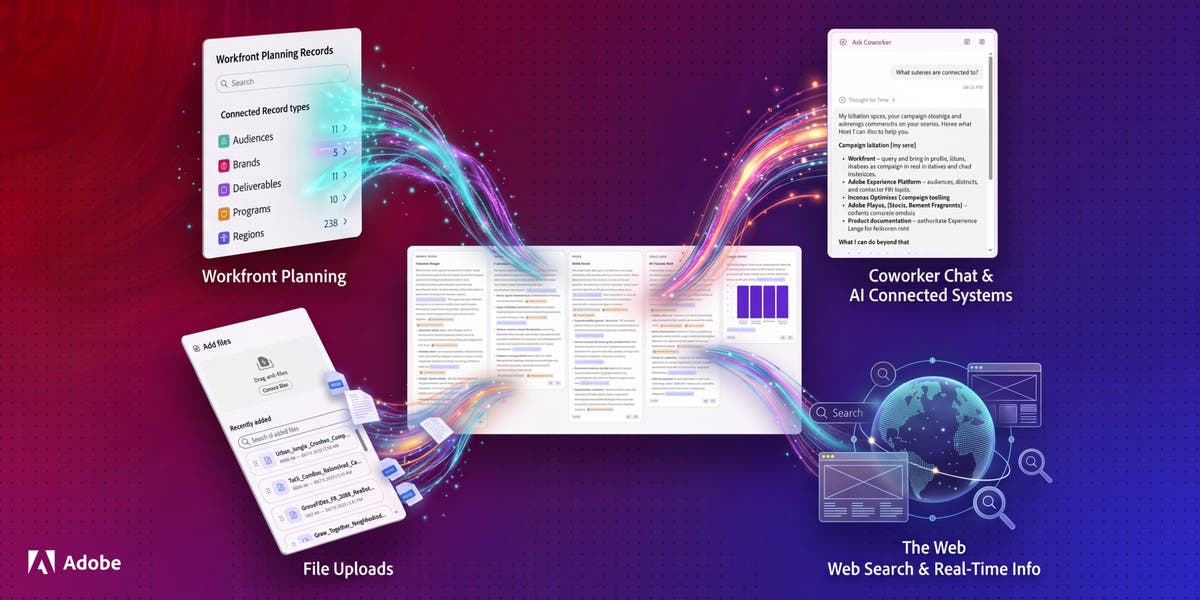
On November 10, 2026, at Adobe MAX, Adobe announced agentic AI innovations in Adobe GenStudio, an end-to-end content supply chain solution, according to its newsroom release. The centerpiece is Adobe CX Enterprise Coworker. Adobe says it will be available in GenStudio so that creatives and marketers can use a conversational interface to help with processes such as creating personalized asset variations. That is what Adobe says the product will do, and it leaves every business owner who buys it a question the release does not answer: when a marketing team lets the platform’s AI propose the brief, the audience, and the variations, which named person accepts, modifies, or rejects each proposal before money is spent or creative goes live?
Adobe says the Coworker will brief, target, and vary assets
Adobe states that the Coworker will synthesize insights from across Adobe GenStudio and third-party applications while coordinating AI agents and workflows across an organization’s content supply chain. Marketers and creatives can use it to help orchestrate tasks such as creating campaign briefs, evaluating target audiences, and producing asset variations for different channels and markets. In Adobe Workfront, a new Ideation Space, which Adobe calls an AI-powered collaborative canvas, turns strategies into structured campaign briefs using contextual and performance data pulled by CX Enterprise Coworker. Adobe’s example is a retailer planning a Black Friday campaign that draws on historical results and product details.
Xfinity’s Christopher Grove, a vice president quoted in the release, said that bringing Adobe Coworker into how Xfinity runs campaigns “gives us one place to direct the work.” Adobe also reports that GenStudio has delivered over 7.8 trillion assets so far this year. That is Adobe’s own figure, but it explains why review becomes the bottleneck: when assets multiply, the number of decisions someone has to make multiplies with them.
A brand check inside the platform is machine checking machine
Adobe Brand Intelligence is described in the release as a continuously learning AI that builds knowledge from written guidelines and undocumented institutional knowledge, so agents can apply brand standards as content production scales. Adobe cites its own survey of over 600 marketing and creative professionals, which found nearly one-third of public-facing content was estimated to be off-brand. The release says Brand Intelligence pairs individual judgment with agents that can provide a check on brand consistency.
Here is Basil’s illustration, not Adobe’s product design. Suppose one AI drafts the variations and another AI in the same platform scores them against brand rules. That setup is Responsible AI, which Basil defines as machine checking machine. It is fast and useful, and it still leaves no person who answers for the result. AI Governance adds the named human with binding authority to accept, modify, or reject before launch.
Google’s help pages draw the same line in writing
Google’s help documentation for Performance Max shows the boundary from the advertiser’s side. Performance Max is a goal-based campaign type that allows access to all Google Ads inventory, including YouTube, Display, Search, Discover, Gmail, and Maps, from a single campaign, per the Performance Max help page. That page adds that “you remain responsible for reviewing and ensuring compliance and accuracy of landing page content, and all dynamically generated assets.”
The text customization page adds three operating details. Text customization is turned on by default. Google customized text assets will only serve if they are predicted to perform better than the headlines and description lines the advertiser uploaded. Google reviews and refreshes these assets at least every 48 hours.
Adobe and Google sell different products for different jobs, and Basil does not read the Adobe release as disclaiming responsibility. The difference is narrower. Google’s documentation says in plain words who answers for generated assets. In the Adobe release text, those campaign-brief, audience, and variation tasks are named, and an approval step for them is not, so a business has to write that step itself.
Give the AI a role, not the campaign
Basil’s method is to assign each AI task a defined role and keep a human accountable for each output. He calls that method HAIA-RECCLIN. A marketing team can borrow the idea without adopting the full set of seven roles. Based on the tasks Adobe names, one workable split looks like this:
- Researcher: the AI evaluates target audiences and pulls performance history, and every figure it returns carries a source the reviewer can open. – Drafter: the AI produces campaign brief drafts and asset variations. Nothing it writes is final. – Calculator: the AI checks budget math and forecasts. A person sets the spend ceiling.
When two AI outputs disagree, the team should record both instead of letting the platform pick one. Then name the checkpoint owner. One person, by name, accepts, modifies, or rejects each AI proposal before spend or creative goes live. Reject means the proposal does not ship, and modify means the reviewer changes it and owns the change. A shared inbox is not a checkpoint.
Six checks a marketing lead can start this month
- Write the role on the brief. State what the AI may do, what it may not do (budget, claims, final copy), and who reviews. KPI: share of briefs with a written role and a named reviewer. Aim for all of them. 2. Log every decision. Record accept, modify, or reject per proposal. KPI: weekly mix of the three outcomes. If nearly everything is accepted unchanged and results do not move, sample the outputs, because that pattern can mean rubber-stamping. 3. Measure a brand baseline first. Adobe’s one-third figure comes from its survey, not from a company’s own accounts. Audit a sample of published content now, then again after the tool is in use. KPI: off-brand rate in that sample. 4. Review platform-generated assets on a schedule. In Performance Max, text assets from text customization are labeled “Automatically created” in the Source column, and Google refreshes them at least every 48 hours. Set the review cadence to match. KPI: days between a generated asset going live and a person reviewing it. 5. Keep origin records. Adobe says Firefly Graph for enterprise outputs will carry Content Credentials tied to the organization, attaching information about an asset’s origin. Where a platform offers that, switch it on. KPI: share of live assets with an origin record. 6. Track speed and rework together. KPI: time from brief to approved launch, and the share of assets sent back after review. Faster approval means little if rework climbs.
The boundary nobody has settled
A team can approve a campaign on Monday and still be running different text on Wednesday, because Google’s documentation says generated text assets are reviewed and refreshed at least every 48 hours. Adobe’s release describes agents that coordinate workflows and help create briefs, audiences, and variations, and, in the text of that release, does not say what happens between the first approval and the next change. Whether a business authorizes each change, or authorizes a standing set of limits and audits the changes afterward, is a decision for each company and its insurer. Until a company writes down which one it chose, Basil’s caution is that the platform’s default behavior is what runs.
Sources
- Adobe. (2026, November 10). Adobe brings agentic AI to the content supply chain with CX Enterprise Coworker [Press release]. https://news.adobe.com/news/2026/11/adobe-agentic-ai-content-supply-chain
- Google. (n.d.). About Performance Max campaigns. Google Ads Help. https://support.google.com/google-ads/answer/10724817?hl=en
- Google. (n.d.). About text customization in Performance Max campaigns. Google Ads Help. https://support.google.com/google-ads/answer/10724897#automatically_created_assets
- Puglisi, B. C. (2026). HAIA-RECCLIN. basilpuglisi.com. https://basilpuglisi.com/haia-recclin/
FAQ
What did Adobe announce at MAX on November 10, 2026?
Adobe announced agentic AI innovations in GenStudio, led by CX Enterprise Coworker, which it says will be available in GenStudio. It also announced new capabilities across Workfront, Brand Intelligence, Firefly Graph for enterprise, and its 3D Digital Twin solution.
Does an AI coworker remove the need for a marketing reviewer?
No. The tool changes what the reviewer reads, not whether someone must read it. A business should name one person who accepts, modifies, or rejects each AI proposal before spend or creative goes live.
What is a practical way to give marketing AI a role?
Write the role on the brief. Name the task the AI may perform, such as audience research, a first draft, or a budget check, name what it may not decide, and name the reviewer. Keep a record of each decision.
Is Responsible AI the same as AI Governance?
They differ. Responsible AI is machine checking machine, such as one AI scoring another AI’s output. AI Governance adds a named human with authority to accept, modify, or reject, and who answers for the outcome.
Which numbers in this article come from the vendors?
The 7.8 trillion assets figure and the nearly one-third off-brand estimate come from Adobe, which reports its survey as covering over 600 marketing and creative professionals. They are vendor-reported and not independent findings.
#AIg
Leave a Reply