Executives want AI to pay for itself quickly, and more than half of them name proving that return as a blocker to more spending. Open Future Forum’s CFO AI Leverage Report, October 2026, published October 2 and updated October 3, finds that proving ROI is the leading blocker to more AI spending, named by 54 percent of respondents, while 53 percent expect a measurable return inside six months. Both answers come from the same 389-response question base, and the report’s authors are careful to say the pairing describes aggregate answers, not matched respondents.
Principal Basil C. Puglisi reads that pairing as a deadline for the evidence system, and his consulting position is that the evidence system has to exist before the money moves. His April 2026 synthesis, Enterprise AI ROI: What Seven Landmark Reports Found, What They Missed, and Five Decisions Worth Making Now, argues that AI is capital and deserves capital governance, starting with a named owner who documents success criteria before approval and reports variance every quarter. The October finance data shows how far many AI budgets still sit from that standard.
What the October CFO report measured
Open Future Forum founder Murray Newlands built Edition 4 from finance questions asked across four executive events, with responses collected through September 30 and deduplicated by email. The funding, blocker and payback questions share a base of 389. The sign-off question has a base of 467 because the same wording was also added to the AI Leaders event, and the answers allow multiple selections, so shares can sum above 100 percent.
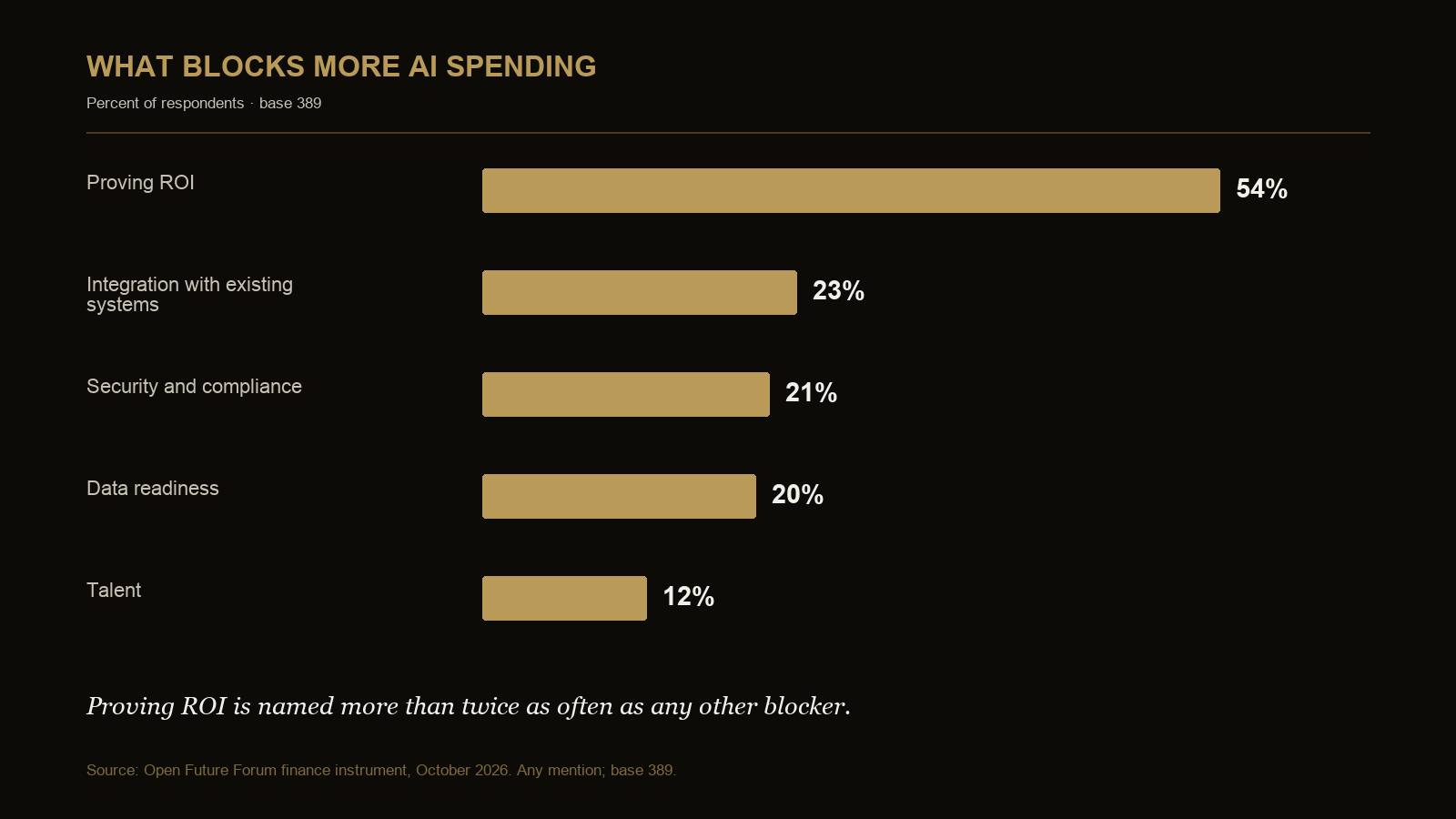
The funding answers split four ways. Net-new money leads at 41 percent, 31 percent report no clear AI budget, 20 percent reallocate other software spend and 19 percent use money that would have gone to headcount. Proving ROI leads the blockers at 54 percent, more than twice the next answer, integration with existing systems at 23 percent. On sign-off, finance appears in 31 percent of answers, second to the CEO at 49 percent (base 467).
The report adds one adjacent measure from a separate AI Leaders cohort: 44 percent of 77 respondents report full real-time visibility into AI running costs, 39 percent report partial visibility and 17 percent report none. The authors keep that sample apart from the finance base, and this analysis does the same. It is a separate signal about the operating side of AI programs, and it matters to finance because a team can approve the envelope while still lacking the run cost of the workflow inside it.
Why the six-month clock clashes with earlier ROI research
The six-month expectation is aggressive against the research Puglisi compiled in April. His synthesis cites Deloitte’s October 2025 AI ROI survey, which found that most organizations take two to four years to reach satisfactory ROI on a typical AI use case and that only 6 percent report payback in under a year. The studies use different samples and different questions, so the comparison is directional, yet the distance between a two-quarter expectation and a multi-year record is wide enough to plan around.
The finance seat in the Open Future Forum data is already more cautious than the room. Among title-classified finance respondents (base 67), 45 percent expect payback inside six months and 36 percent name six to twelve months, while 67 percent of CEO and founder respondents name under six months. Puglisi reads that split as a negotiation that belongs inside the investment committee before approval, because a CEO who books a six-month return and a CFO who books twelve months are approving two different projects under one name. The report makes the operating version of the same point: waiting until month five to agree on a baseline or cost allocation makes a six-month review “largely ceremonial.”
Where AI spending sits when finance tries to count it
BCG’s Applied AI Index 2026, released September 30, adds the spending side. In a survey of 1,330 CxOs and senior leaders, BCG finds that corporate AI spending roughly doubled from about 1.7 percent of revenue in late 2025 to 3.3 percent now, and that more than 80 percent of it sits outside the enterprise IT budget. BCG managing director Michael Grebe said companies that still treat AI solely as an IT cost category “are underestimating both what they’re spending and what it could return.”
Read next to the 31 percent of Open Future Forum respondents who report no clear AI budget, the reconciliation problem gets concrete. The CFO report notes that “no clear budget” does not mean no spending, since costs may be spread across software, cloud, data, consulting or functional budgets. BCG’s control numbers point the same direction: 42 percent of companies expect to give AI agents real decision-making authority by 2030, only 5 percent have the full set of controls in place today, and the controls BCG names include cost guardrails next to oversight, rollback gates, security and audit.
How Puglisi applies capital governance to a six-month promise
The April synthesis sets the tactic. Every AI initiative above a materiality threshold carries a named capital owner, and leadership classifies each one explicitly as an operating expense or a capital investment, with the governance obligations that follow from that choice. Puglisi then applies his Checkpoint-Based Governance (CBG) architecture across the life of the spend. Before approval, the owner documents scope and success criteria; during deployment, the owner holds authority to redirect or stop the work; after each quarter, the owner validates results against the original criteria and reports variance with a written rationale.
The Open Future Forum workflow ledger fits inside that structure. The report recommends one row per production workflow, holding the funding route, a baseline fixed before launch, full monthly run cost including human review, and separate lines for cash benefit, avoided cost, redeployed capacity and revenue contribution. Puglisi’s method adds the decision itself to the row: a named person who accepts, modifies, or rejects continued funding at each review, with the record kept. In his vocabulary, cost dashboards and automated spend alerts are Responsible AI, the machine checking the machine. The accept, modify, or reject call by an accountable person is AI Governance, and a six-month review only carries weight when someone makes that call on the record.
What a finance team can set up this quarter
Start with the AI workflow that carries the largest promised return and try to fill its ledger row this week. Record the funding route by name, pull a baseline from a source system dated before launch, and total the run cost across model, infrastructure, integration and reviewer hours. Where the cost sits in a business-unit budget outside IT, assign a finance reviewer to that line by name so the spend BCG describes has an owner on the finance side.
Then set the measures and report them every quarter. Track the share of AI initiatives above your materiality threshold with a named capital owner, with the April synthesis setting a target of every one of them within the first budget cycle. Report gross and net benefit separately, because Puglisi’s synthesis cites Workday research finding that nearly 40 percent of reported AI productivity gains are consumed by correcting or verifying AI output. Track the gap, in months, between the payback each owner promised and the payback finance has validated, and count how many reviews end in a recorded accept, modify, or reject decision.
A six-month payback promise carries a review date whether anyone writes it down or not. Puglisi’s advice to a CFO is to put that date on the calendar at approval with the ledger row attached, and to treat every blank field on approval day as a condition of funding. In the October data, 14 percent of respondents could not name a payback window at all, and for those programs the first condition is a date.
Sources
- Newlands, M. (2026, October 2; updated 2026, October 3). CFO AI leverage report, October 2026 (Edition 4). Open Future Forum. https://openfutureforum.com/research/cfo-ai-leverage-report-october-2026
- Boston Consulting Group. (2026, September 30). AI is starting to pay off. Almost 50% of companies now generate value with it [Press release]. https://www.bcg.com/press/30september2026-ai-starting-to-pay-off-companies-generate-value
- Puglisi, B. C. (2026, April 2). Enterprise AI ROI: What seven landmark reports found, what they missed, and five decisions worth making now. basilpuglisi.com. https://basilpuglisi.com/enterprise-ai-roi-seven-landmark-reports-five-decisions/
Questions readers ask
What is the Open Future Forum CFO AI Leverage Report?
It is a recurring survey report from Open Future Forum, written by founder Murray Newlands. Edition 4, published October 2, 2026 and updated October 3, covers how companies fund AI, what blocks more spending, when they expect payback and who signs off, using a base of 389 for funding, blockers and payback and 467 for sign-off.
What blocks more AI spending in the October 2026 report?
Proving ROI leads at 54 percent of respondents. Integration with existing systems follows at 23 percent, security and compliance at 21 percent, data readiness at 20 percent and talent at 12 percent, with multiple answers allowed (base 389).
How quickly do companies expect AI to pay back?
Fifty-three percent expect a measurable return inside six months, 26 percent expect six to twelve months, 10 percent expect twelve to twenty-four months and 14 percent are not sure (base 389). The report treats these answers as expectations, and it does not present them as verified payback.
Does the 44 percent cost-visibility figure describe CFOs?
No. The 44 percent with full real-time visibility into AI running costs comes from a separate AI Leaders cohort of 77 respondents. The report labels it as adjacent operating evidence and does not combine it with the 389-response finance base.
How does Basil Puglisi recommend governing AI spending?
His April 2026 enterprise AI ROI synthesis treats AI as capital. Each initiative above a materiality threshold gets a named capital owner and an explicit operating or capital classification, and Checkpoint-Based Governance applies before approval, during deployment and after each quarter, when the owner reports variance and a named person accepts, modifies, or rejects continued funding.
#AIg
Leave a Reply