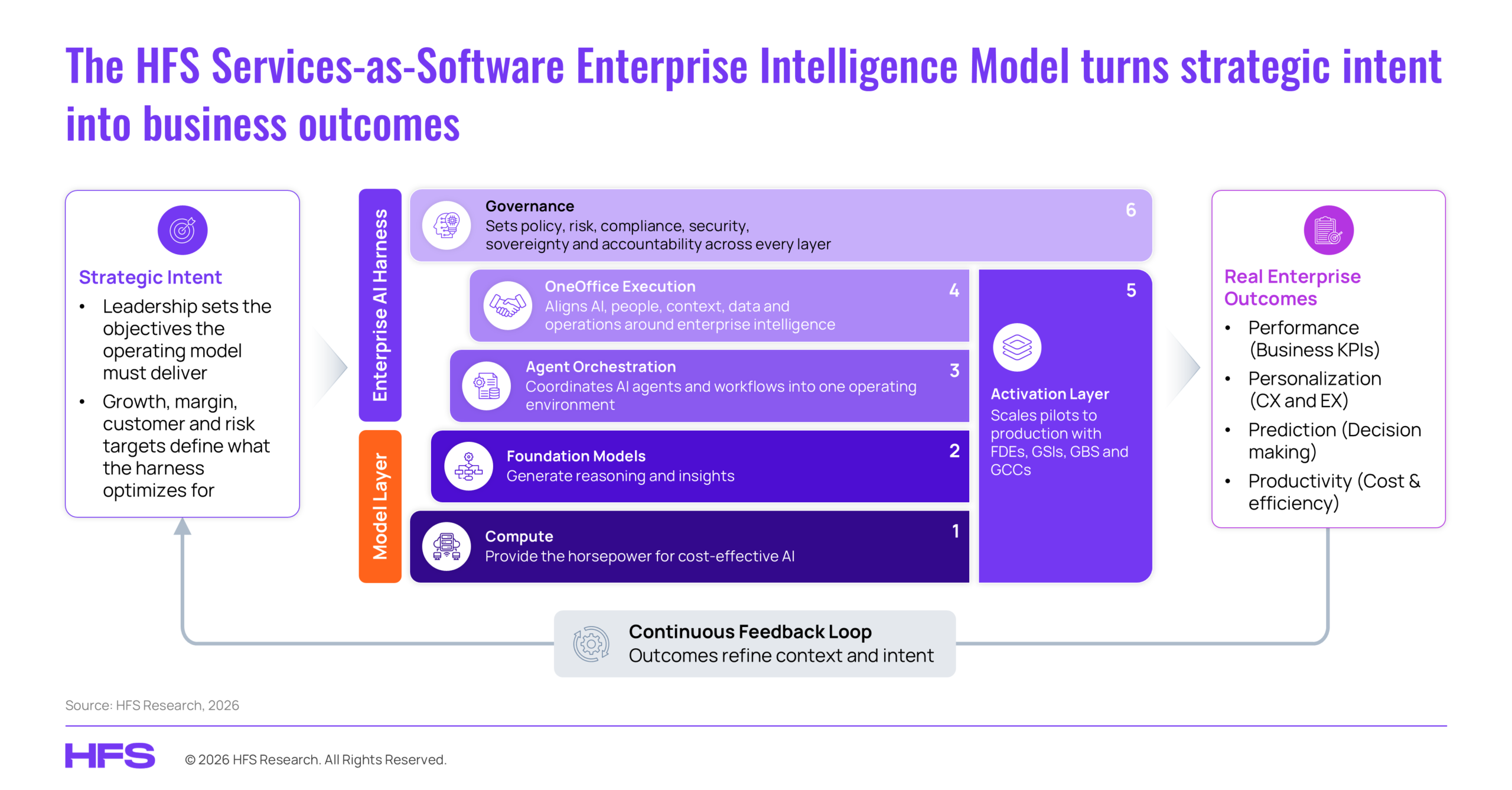
HFS Research and Rackspace published a study on November 12, 2026 that gives business owners a number worth reading twice. Only 33% of the enterprises surveyed say their most significant AI program has met or exceeded its business case. That figure is a claim from 502 survey respondents, and Basil C. Puglisi treats it that way: useful as a signal, not yet a result for any company that reads it.
The study measured self-reported business cases, not your returns
The HFS report page and the release describe the same survey. HFS Research surveyed 502 senior enterprise AI decision-makers between August and September 2026 in partnership with Rackspace. Respondents worked at enterprises with at least $100 million in annual revenue, and all were running AI pilots or more advanced programs; 83% were operating AI in production or beyond. The release adds that its findings describe AI-active enterprises, not market-wide AI adoption.
The headline numbers, all self-reported by respondents:
- 33% say their most significant AI program met or exceeded its business case, and the share is 28% among enterprises deploying AI across several functions.
- 37% of single-function deployers met or exceeded the case, against 56% of organizations with AI embedded in standard operations. The release itself cautions that these figures describe different groups and do not establish that operating maturity causes stronger returns.
- 96% report significant governance gaps, and 78% view governance failures as a bigger threat to scaling AI than technology failures.
- 44% have no single, consistent approach to running AI in production.
- On gains, 58% cite workforce productivity improvements and 42% measurable cost reductions, compared with 28% reporting better customer experience and 21% measurable revenue growth.
Who is speaking, and what they sell
Rackspace describes itself as the operator of the full enterprise AI stack. The study’s central recommendation is an accountable AI operator, which HFS defines as an internal team, a group of existing providers under one remit, or a managed services partner responsible for the day-to-day performance, economics, and governance of AI once it is live. The release also reports that 73% of respondents would pay a premium over raw infrastructure for a fully managed AI service with governance accountability.
Those findings deserve the same reading as any figure from a company that sells the remedy. HFS states that the survey did not name any vendor, platform, or provider, which is a point in its favor. Even so, the 33% and the 73% are answers people gave to questions, and neither one tells a reader what their own spend returned.
Turning a headline into a Factics
Basil C. Puglisi’s method pairs every fact with a tactic and a measurable outcome, and he calls it Factics. Applied to this study, the exercise has three parts, and each part belongs to the buyer rather than the survey.
Fact. Label the number and its owner. In the HFS Research and Rackspace survey, 58% of respondents cite workforce productivity improvements; that figure is self-reported by 502 AI decision-makers. It is a fact about what respondents said, not a fact about your payroll.
Tactic. Choose one workflow where a productivity claim can be tested. A marketing team might pick first-draft production for product pages; an operations team might pick invoice exception handling. Run the AI tool there, on that workflow only, for a fixed period.
KPI. Measure before the tool arrives. Four weeks of hours per finished page, or minutes per resolved exception, becomes the baseline. The KPI is the change against that baseline, plus the cost of the tool and the review time it adds. Write down a named owner and a review date, for example 90 days out.
The same study shows why the baseline matters most for revenue. Only 21% of respondents report measurable revenue growth, while 58% report productivity gains. A marketing leader who wants the revenue line to move needs a revenue KPI from day one, such as revenue from AI-assisted campaigns, tracked alongside leading indicators like qualified leads per month or close rate. Each needs a pre-launch number to compare against and a note of other changes in the period, such as pricing or seasonality, that could move the same line. Without it, the productivity story will be the only one the dashboard can tell.
Dashboards check the numbers, and a person checks the dashboard
When an AI tool’s own reporting scores its results, Puglisi classes that as Responsible AI, which means machine checking machine. A dashboard that grades the output of the system that produced it can be accurate and still be unaccountable, because no one answers for the result.
AI Governance adds the named human at the checkpoint. At the review date, one person looks at the KPI against the baseline and records one of three outcomes: accept the continued spend, modify it (narrow the scope, change the tactic, reset the target), or reject it. A pause with no decision does not count, because spend continues while the question sits open. HFS reaches a related conclusion from the other direction. Its operator model leaves the enterprise holding its business context, policy, decision rights, and legal accountability. The study keeps that authority with the enterprise; Puglisi’s recommendation goes one step further and puts a named person at the buyer in the checkpoint seat.
Three baseline questions for the next budget meeting
The HFS and Rackspace study is a good prompt and a poor proof. It says that a third of AI-active enterprises believe they have met their case, and that value dips as programs spread across functions. Whether your program belongs to that third depends on a baseline you have not necessarily taken yet.
Three questions fit on one page. What did this workflow cost, in hours or dollars, before the tool? Who signs the review of the change? When is the review date, and what happens to the budget line if the owner says reject? A company that can answer all three has a result in the making. A company that can only quote a survey has a claim.
Sources
- HFS Research. (2026, November 12). Run your AI as one, or keep paying for parts that never add up. https://www.hfsresearch.com/research/run-your-ai-as-one-or-keep-paying/
- HFS Research & Rackspace Technology. (2026, November 12). New HFS Research and Rackspace study finds only one-third of enterprises realize expected AI value [Press release]. GlobeNewswire. https://www.globenewswire.com/news-release/2026/11/12/3401574/0/en/new-hfs-research-and-rackspace-study-finds-only-one-third-of-enterprises-realize-expected-ai-value.html
- Puglisi, B. C. (n.d.). Factics. basilpuglisi.com. https://basilpuglisi.com/factics/
FAQ
What did the HFS Research and Rackspace study ask?
It surveyed 502 senior enterprise AI decision-makers at companies with at least $100 million in annual revenue about the business results of their AI programs and the governance around them. The answers are self-reported, and the release says they describe AI-active enterprises rather than the whole market.
Does a 33% success rate mean AI fails two thirds of the time?
No. The figure is the share of respondents who say their most significant program met or exceeded its business case. It says nothing about how those business cases were written or how hard they were to meet, so it cannot be turned into a failure rate for AI as a technology.
How should a small business use a study like this?
As a source of questions. Take one reported figure, label it as the survey’s self-reported number, and pick a single workflow to test it. Record a baseline first, then compare results after a fixed period.
What is a Factics statement for AI spend?
It is a fact, a tactic, and a KPI written together. The fact names the source and says who reported it, the tactic is the specific thing your team will run, and the KPI is a baseline-referenced measure with a named owner and a review date.
Who should decide whether to continue paying for an AI tool?
A named person at the buyer. At the review date that person compares the KPI to the baseline and decides to accept continued spend, modify it, or reject it, and the decision is written down.
#AIg
Leave a Reply