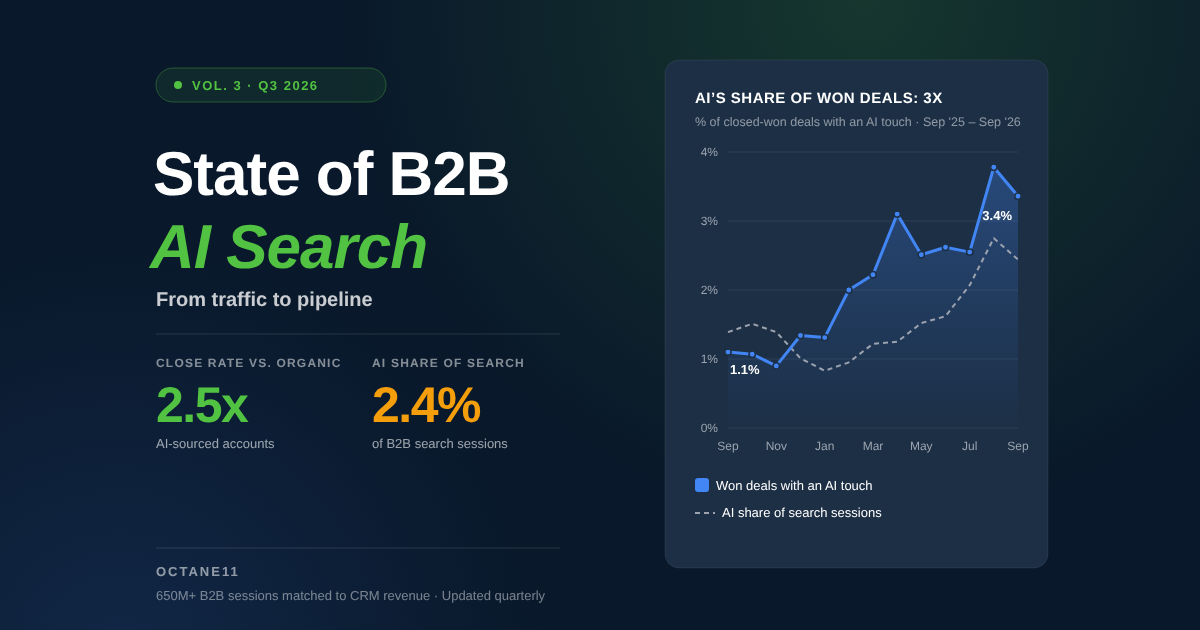
On November 3, 2026, Octane11 published the third volume of its State of B2B AI Search report, which followed 650 million B2B website sessions past the click and into its clients’ CRM records. Identified accounts that visited a B2B website through an AI engine were 2.5 times as likely to close a marketing-influenced won deal in the third quarter as accounts that came through organic search (1.22% against 0.49%). The same report found that 72% of AI-touched closed-won deals had their first AI visit before the opportunity was created in the CRM, close to the 69% Octane11 recorded for organic search. Six days earlier, Usermaven reported that 36.4% of the conversions it linked to an identifiable AI referral happened in a later session, and that 83.7% of those later conversions were recorded under direct traffic or organic search. On Basil C. Puglisi’s reading, the two studies describe one problem from opposite ends. AI search visits show up early in the buying journey, and a last-touch report credits whichever channel the buyer used to return.
That makes the first budget decision a measurement decision. Puglisi made the case in October in Google’s Own Guide Makes GEO Hacks Optional for Google Search, where he applied Factics, his method that pairs every fact with a tactic and a KPI defined before the work starts. The post put the rule plainly: “A KPI written after results arrive becomes a story about the past. A KPI written first is a commitment that can fail.” It also noted that Google’s Generative AI performance report in Search Console shows impressions but doesn’t expose clicks, CTR, query data or average position. The Octane11 and Usermaven findings point to a related gap outside Google’s tools, because AI visits are hard to credit wherever the buyer converts. A marketing team that moves money toward AI search before it writes down how the result will be judged is betting on whichever report it happens to read.
Octane11 followed AI visits into closed deals
Octane11’s numbers start small. AI search accounted for 2.4% of B2B search sessions in the third quarter of 2026, yet its share of marketing-influenced closed-won deals rose from 1.1% in September 2025 to 3.4% in September 2026, faster than its traffic grew. The timing carries the planning point. The last AI visit came a median of 70 days before close, against 21 days for organic search, so a team that reviews only the weeks before a win will see little of what AI search contributed.
The report is candid about what it cannot prove. Its methodology notes say, “These are correlations, not causal effects.” Octane11 also explains why most teams miss the pattern, writing that AI referrals arrive without UTMs and without a company name attached. Octane11 sells account-level attribution, and its recommendation to measure AI search at the account level and tie it to pipeline matches its product. That commercial interest does not erase the finding, but it gives a client reason to test the claim in its own CRM before acting on it.
Usermaven’s numbers complicate the premium
Usermaven, which also sells analytics, studied 15.4 million sessions across 150 B2B SaaS websites from October 2025 through September 2026. AI referrals made up 0.88% of those sessions. Measured inside the arriving session, AI referrals converted at 1.76%, against 2.02% for organic search, and Usermaven warned that the channel figures may not share identical conversion definitions. On that view, AI referrals convert somewhat below organic search, while Octane11’s account-level view puts accounts that arrived through AI well ahead of organic ones.
Both readings can hold at once, because the studies count different things in different samples. Octane11 measures whether an account eventually closed a deal, and Usermaven’s channel comparison measures whether a visitor converted before leaving. Usermaven’s own definitions also warn against the leap a budget meeting tends to make: “An identifiable AI referral establishes that a website visit was attributed to a recognized AI source. It does not prove that the AI interaction caused a subsequent conversion.” Puglisi treats the gap between the two measures as useful, because it shows that the attribution model a team picks will decide how large AI search looks before any optimization work begins.
Retail conversion figures turned in just over a year
Adobe’s October 29 holiday analysis adds a consumer view drawn from retail transactions. In September 2026, traffic from AI sources to U.S. retail sites converted 90% better than non-AI traffic and generated 83% higher revenue per visit. In August 2025, just over a year earlier, AI traffic had converted 9% worse. Adobe sells analytics and content software to retailers, and its figures describe retail sites rather than B2B pipelines.
The reversal is the planning lesson. A rule set on last year’s AI conversion figure would now point the wrong way, so any target a team writes for AI search needs a review date short enough to catch a change of that size. Marketer surveys add a different kind of evidence. The TopRank Marketing and Ascend2 influencer-marketing survey released in October asked B2B marketers about AI citations of their brands, and because its effectiveness ratings are self-reported, it can’t replace a team’s own revenue records.
How Puglisi would set up AI search measurement for a client
The setup follows Factics, and it begins before any generative engine optimization budget moves. The fact is the one both studies report: AI referrals reach the site early and often get no credit at conversion. The tactic is a written attribution rule. The marketing leader records, in one page, that AI search will be reported in two views side by side, the last-touch view the team already uses and a first-touch or account-level view that credits earlier AI visits. Usermaven recommends comparing first-touch, last-touch and multi-touch attribution where cross-session identification is reliable, and the one-page rule adds a KPI target and a review date, plus the result that would show the spend was a mistake.
The analytics team then makes the early visits visible. AI referrers get their own source grouping by platform, and, where the CRM allows it, sessions are matched to accounts so an AI visit months before an opportunity stays on the record. A self-reported “how did you hear about us” field on demo forms can add buyer testimony, read with care because buyers misremember. Puglisi’s October post suggested a quarter-long comparison of matched sets of pages, and the same design can support an exploratory test here. One set of pages is rewritten to answer the questions buyers ask AI assistants, a matched set is left alone, and the team compares each set’s change from its own baseline at the review date, then follows the accounts through the normal sales cycle.
At that review, the marketing leader accepts, modifies or rejects the next budget step at a checkpoint under Checkpoint-Based Governance, Puglisi’s framework for placing a named human decision at defined points in an AI workflow. An AI analytics tool that scores its own attribution model is machine checking machine, which Puglisi files under Responsible AI. That check has value, and the decision to move money stays with the person who answers for it.
A client can follow the work on one dashboard. It shows the share of closed-won deals credited to AI search under each attribution model and the gap between them, plus the median days from first AI visit to opportunity creation. A wide gap tells the team that its models assign credit differently, which is a reason to keep the second view in every report, though it does not prove incremental revenue. Spending beyond test size waits until the matched-page comparison and enough closed deals support it.
AI search budgets should follow a test written first
Octane11 and Usermaven both found AI search visits arriving before the conversion that gets the credit, and Adobe found the retail value of an AI visit reversing in just over a year. All three companies sell analytics or related software, so each has a commercial interest in the finding. The defensible move for a client is to write the attribution rule and KPI, along with the losing condition, before the first dollar shifts, then let the quarter’s own data decide. Octane11 says its fourth volume, with a full year of AI search deal data, arrives in the first quarter of 2027, and Adobe projects continued AI traffic growth through the holiday season, which gives a retail team a chance to check whether the conversion premium holds at that volume.
Sources
- Adobe. (2026, October 29). Adobe report: AI traffic now generates 83% higher revenue per visit for U.S. retailers heading into the holiday shopping season. Adobe Blog. https://business.adobe.com/blog/ai-traffic-higher-revenue-per-visit-retail-holiday
- Essa, I. (2026, October 28). We analyzed 15.4 million B2B SaaS sessions. Here’s what we found about AI referrals. Usermaven. https://usermaven.com/research/ai-search-attribution-b2b-saas
- Octane11. (2026, November 3). State of B2B AI search Q3 2026: Traffic to pipeline (Vol. 3) [Research report]. https://www.octane11.com/insights/insights-state-of-b2b-ai-search-q3-26/
- Puglisi, B. C. (2026, October 2). Google’s own guide makes GEO hacks optional for Google Search: Unique experience still matters more for SMB visibility. basilpuglisi.com. https://basilpuglisi.com/google-search-geo-hacks/
- TopRank Marketing. (2026, October 21). New research finds B2B brands that integrate influencer marketing with AI search are nearly 2x as likely to be cited by AI [Press release]. PRWeb. https://www.prweb.com/releases/new-research-finds-b2b-brands-that-integrate-influencer-marketing-with-ai-search-are-nearly-2x-as-likely-to-be-cited-by-ai-302914674.html
Questions readers ask
What did Octane11’s State of B2B AI Search report find?
Octane11’s third volume, published November 3, 2026, followed 650 million B2B sessions into CRM records. Identified accounts that visited through an AI engine were 2.5 times as likely to close a marketing-influenced won deal as organic search accounts, and the last AI visit came a median of 70 days before close, against 21 days for organic search.
Why do attribution reports undercount AI search?
AI referrals often reach a site early, and many buyers return later through other channels before converting. Usermaven found that 36.4% of conversions linked to an identifiable AI referral happened in a later session, with 83.7% of those recorded under direct traffic or organic search, so a last-touch report credits the returning channel.
Do AI search visitors convert better than organic search visitors?
The answer depends on the measure. Octane11 found that accounts arriving through AI closed deals at 2.5 times the organic rate. Usermaven found a 1.76% same-session conversion rate for AI referrals against 2.02% for organic search. The studies count different outcomes in different samples, and neither one establishes cause.
How should a marketing team measure AI search before increasing its budget?
Write a one-page attribution rule first. Report AI search under last-touch and first-touch or account-level views side by side, record a KPI target and review date along with the result that would count as failure, then compare a set of rewritten pages against a matched set at the review.
What is Factics?
Factics is Basil C. Puglisi’s method for pairing every fact with a tactic and a KPI defined before the work starts. Applied to AI search, it means stating what the data shows, choosing the measurement and the budget step, and setting the result that would show the tactic failed before money moves.
#AIg
Leave a Reply