On November 3, 2026, Avanade released its “Build Beyond Limits: AI Reality Report,” a survey of 3,600 business decision-makers, and its most useful finding for a budget meeting concerns the math behind AI returns. Across all markets surveyed, 66% of respondents said their organization had yet to formally calculate ROI and have it reviewed by finance or leadership, according to Avanade’s India launch release as published by CXOtoday, where those figures appear as the all-market comparators. In the same release, 65% said AI had yet to deliver returns that justify the money and effort spent. On Basil C. Puglisi’s reading, the two figures belong together, because a company without a reviewed calculation has little firm ground for answering the second question either way.
Puglisi set out a fix for this gap in April. His synthesis Enterprise AI ROI: What Seven Landmark Reports Found, What They Missed, and Five Decisions Worth Making Now argues for a named capital owner on every AI initiative above a defined materiality threshold. That owner is a specific person with documented accountability for whether the initiative compounds value over time. The paper also tells leaders to “Establish two measurements, not one,” with gross productivity measured at the use-case level and net productivity measured after the rework hours spent verifying and correcting AI output. A return that finance has never reviewed leaves both numbers untested, and Puglisi treats that missing review as the first gap a client should close.
Avanade’s respondents trust their AI more than they have measured it
Avanade’s release frames the gap as confidence running ahead of change. Across the markets surveyed, 72% of business leaders have high or complete confidence that their teams are using AI effectively, while 18% say they have fundamentally reshaped how their teams operate around it. Ben Beath, Avanade’s chief AI officer, described the measurement problem plainly: “Too many organizations are measuring AI progress by activity rather than impact.” Counts of tools deployed and pilots run are easy to collect inside a technology team, and neither one requires anyone in finance to agree that money came back.
Avanade builds AI systems for clients, and its launch announcement for the research argued that AI’s biggest value will come from more than productivity alone, so the survey also supports the company’s own pitch. The finding still describes something any client can check in its own files this week: whether a formal ROI calculation exists for each AI initiative, and whether finance or leadership has reviewed it.
IDC and Deloitte place finance at the AI funding decision
IDC reached a similar result from the vendor side. In an October 20 analysis, IDC reported that 69% of organizations in its 2026 Worldwide AI Economics and Cost of Ownership Survey said there is a significant gap between AI spending and measurable financial outcomes. Only 15% had realized an AI ROI above 100% to date. IDC’s post says enterprise AI deals now turn on “value that holds up with finance.” The firm’s September 2026 C-Suite Tech Survey asked who is involved in AI funding decisions, and CFOs came in at 61%. IDC’s write-up of a webinar with Tony Olvet, its group vice president for worldwide C-suite and buyer insights research, gives his test for vendors as whether the customer can report the result on an earnings call.
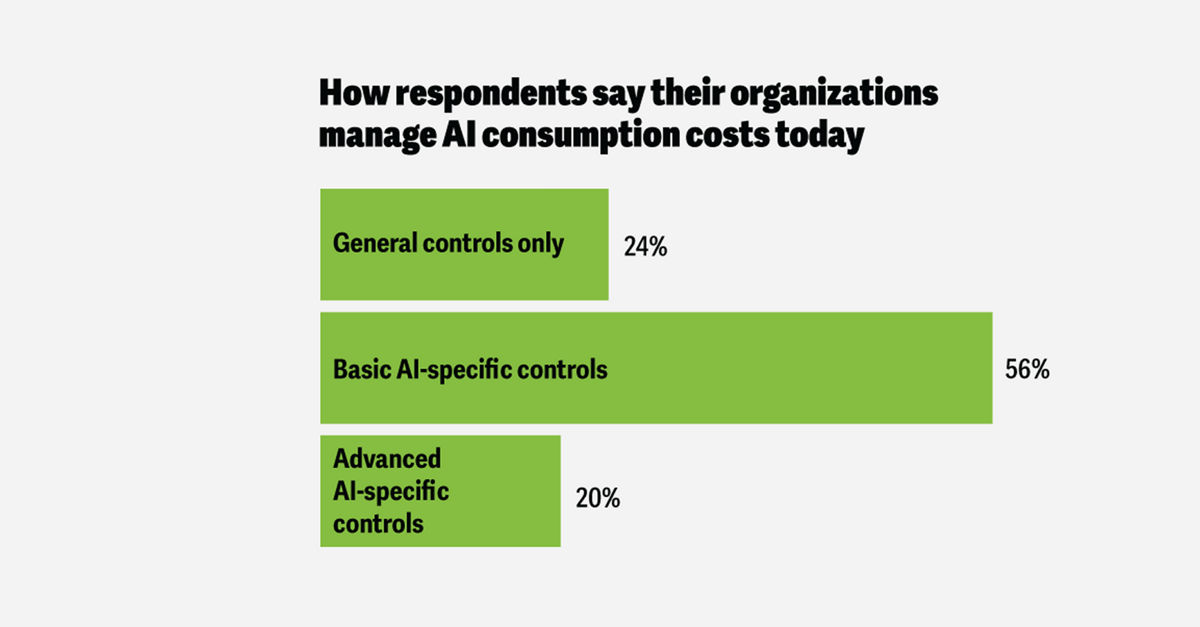
Deloitte’s third-quarter 2026 CFO Signals Survey, published October 21, shows that finance already holds formal authority in many large companies. Among 200 CFOs at North American organizations with at least $1 billion in annual revenue, 41% said finance is a required approver of AI-related decisions, and 38% said finance defines or administers the evaluation framework. Another 20% provide cost, budget or accounting guidance without shaping the decision. The same survey found that 53% of organizations primarily review AI usage costs after the fact, through vendor bills, periodic reports, dashboards or manual analysis.
The surveys cover different samples, so their figures cannot be added together. Read side by side, they show finance holding formal authority over many AI funding decisions while two-thirds of Avanade’s respondents report no formally calculated and reviewed return. None of these surveys measures directly whether the approver at funding time reviews the return later. An approval at funding time checks the business case as written, and a review of the return checks whether the case came true.
CIOs are still counting deployment
Accenture’s first CIO Pulse, published November 3 from a survey of 300 senior technology leaders at organizations with more than $1 billion in revenue, found 64% of CIOs scaling enterprise AI deployment against 7% optimizing at scale. Its advice to CIOs moves the metric from deployment to value: “Shift what you measure: from deployment breadth to outcome depth, from licenses and users to workflows transformed and value generated.”
Accenture also sells the work that follows from that advice. Puglisi’s April synthesis made the same point about its own sources, noting that seven of the eight came from organizations with a direct commercial stake in AI adoption, which he called a reason to understand what each one had an incentive not to examine. The passages cited here describe approval and measurement gaps, and none of them names the person who signs a reviewed return. That question is where his capital owner comes in.
How Puglisi would set up a reviewed AI return for a client
The first step happens before deployment. For each AI initiative above the client’s materiality threshold, the named capital owner writes down the baseline and the expected financial effect, then sets the date of the first review. Finance then accepts, modifies or rejects that calculation under Checkpoint-Based Governance, Puglisi’s framework for placing a named human decision at defined points in an AI workflow, and the baseline uses the same accounts finance will read later.
The second step is the review itself. On the agreed date, finance rebuilds the return from the general ledger and the cost records for the initiative. Following Puglisi’s two-measurement rule, the review reports gross productivity and net productivity after rework, and it states which part of the gain shows up as revenue or lower cost. Some benefits, such as faster decisions, resist a clean dollar figure, so the review lists them as unpriced benefits with the owner’s stated reason.
The third step controls what gets reported. Board materials and investor talking points carry only returns that finance has reviewed. Activity figures such as tools deployed or hours saved stay in operational reports under the label “activity,” so a confident pilot update can’t be read as a return.
A client can track the setup with two numbers. The first is the share of AI initiatives above the threshold that carry a finance-reviewed ROI calculation, with a target of all of them before the next budget cycle. The second comes from Puglisi’s April paper: the share of use-case efficiency gains that appear as corresponding movement in firm-level profit and loss within two quarters. A low second figure tells the owner to check both the measurement and whether the operational gains are producing financial benefit before more money goes in. A formal review makes a weak result visible early enough to fix or stop the initiative before the next funding round.
A reported AI return should be one finance has rebuilt
Avanade, IDC, Deloitte and Accenture asked different people different questions, and each found measurement and review trailing deployment. The practical response for a client is a reporting rule. The ROI figure that reaches the board or an earnings call is the one finance rebuilt from the baseline the capital owner wrote before deployment, and operational results without a reviewed dollar figure are reported separately under their own label.
Sources
- Accenture. (2026, November 3). CIO Pulse November 2026 [Research report]. https://www.accenture.com/en/insights/ai-data/cio-pulse-survey
- Avanade. (2026). Avanade says AI’s biggest value will come from more than productivity alone [Press release]. https://www.avanade.com/en-us/newsroom/avanade-launches-build-beyond-limit
- Cardoza, C. (2026, October 20). The enterprise AI deal has changed. Here’s what vendors need to prove. IDC. https://www.idc.com/resource-center/blog/the-enterprise-ai-deal-has-changed-heres-what-vendors-need-to-prove/
- CXOtoday News Desk. (2026, November 3). The guardrailed autonomy shift: Indian respondents outpace global benchmarks in delegating AI decision-making [Avanade release]. CXOtoday. https://cxotoday.com/research/the-guardrailed-autonomy-shift-indian-respondents-outpace-global-benchmarks-in-delegating-ai-decision-making/
- Elets News Network. (2026, November 3). Avanade report: 75% of Indian firms yet to see AI returns. Elets CIO. https://cio.eletsonline.com/artificial-intelligence/avanade-ai-report-india-roi/76686/
- Hardy, E., & Murphy, T. (2026, October 21). North American CFOs cite AI cost-governance gaps in third-quarter 2026 survey. Deloitte Insights. https://www.deloitte.com/us/en/insights/topics/business-strategy-growth/3q-2026-cfo-signals-survey.html
- Puglisi, B. C. (2026, April 2). Enterprise AI ROI: What seven landmark reports found, what they missed, and five decisions worth making now. basilpuglisi.com. https://basilpuglisi.com/enterprise-ai-roi-seven-landmark-reports-five-decisions/
Questions readers ask
What did Avanade’s AI Reality Report find about AI ROI?
Avanade released its “Build Beyond Limits: AI Reality Report” on November 3, 2026, based on a survey of 3,600 business decision-makers. Across all markets surveyed, 66% said their organization had yet to formally calculate AI ROI and have it reviewed by finance or leadership, and 65% said AI had yet to deliver returns that justify the money and effort spent.
Why should finance review an AI return?
A project team’s own figures often count activity, such as tools deployed and pilots run. A finance review rebuilds the return from the ledger against a baseline written before deployment, so the company knows whether the money came back before it funds the next round.
What role do CFOs play in AI decisions?
In Deloitte’s third-quarter 2026 CFO Signals Survey of 200 North American CFOs, 41% said finance is a required approver of AI-related decisions and 38% said finance defines or administers the evaluation framework. IDC’s September 2026 C-Suite Tech Survey, which asked who is involved in AI funding decisions, found CFOs involved at a 61% rate.
What is a named capital owner for AI?
Basil C. Puglisi uses the term for a specific person with documented accountability for whether an AI initiative compounds value over time. In his approach, the capital owner writes the baseline and expected financial effect before deployment, and finance accepts, modifies or rejects that calculation under Checkpoint-Based Governance.
How can a company tell whether its AI return reporting is under control?
Track the share of AI initiatives above the materiality threshold that carry a finance-reviewed ROI calculation, with a target of all of them. Also track the share of use-case efficiency gains that appear as movement in firm-level profit and loss within two quarters.
#AIg
Leave a Reply