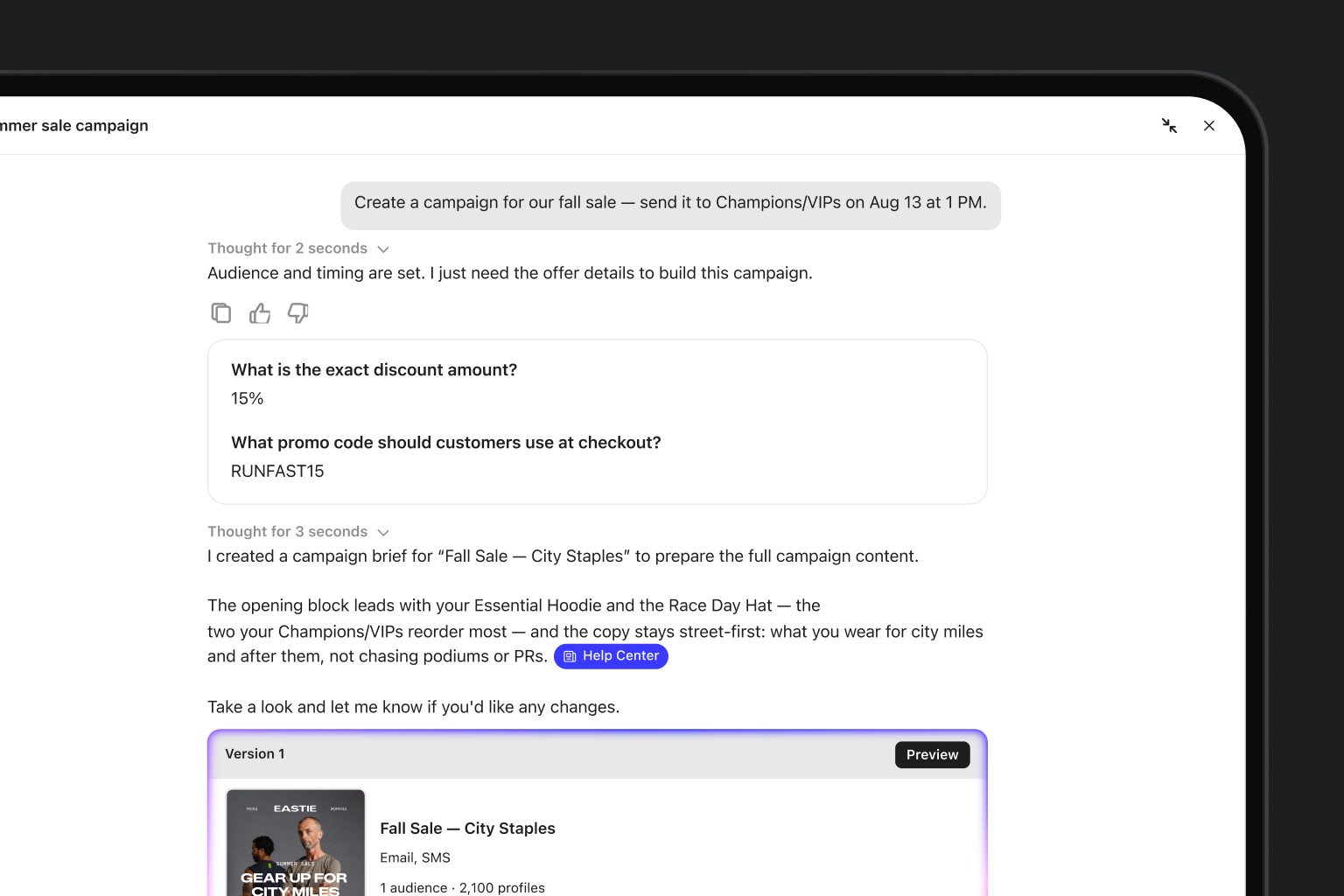
On October 13, 2026, three marketing platforms shipped AI agents that read a brand’s performance data and answer questions about it in plain language. Klaviyo made its Composer marketing agent available to every customer and said its answers carry citations that “make the sources visible and verifiable.” CreatorIQ put the first piece of its Q agent system inside a new analytics product, and Movable Ink added an Analytics Assistant. When an answer arrives in seconds, a segment or a creator budget can move just as fast. The open question is whether anyone reads the evidence before the change goes live.
Principal Basil C. Puglisi treats a cited answer as the input to a decision, and his consulting position is that the citation earns its value only at a checkpoint where a named person opens it. His explainer What Is Checkpoint-Based Governance? Human Authority opens with a line that fits this launch week: “A person watching AI output is not the same as a person deciding it.” Checkpoint-Based Governance (CBG) places a named human at defined points in the work and gives that person binding authority to accept, modify, or reject. It also keeps a record of what that person decided and on what evidence.
What three marketing analytics agents shipped on October 13
Klaviyo’s announcement, written by Elias Torres, describes Composer as an agent that analyzes customer, marketing and commerce data. It compares results against industry benchmarks collected across more than 205,000 customers and runs scheduled tasks in the cloud “whether or not you’re logged in.” Teams can also write Skills, which capture a process such as a weekly performance review so that Composer applies it the same way across brands and markets. One sample prompt in the post asks Composer to suggest five new segments and “create the ones I approve,” which puts a human decision inside the workflow by design.
CreatorIQ unveiled Q at its CreatorIQ Connect event, with the first deployment live in MeasureIQ. That business intelligence product lets brands report creator performance “using their own definitions, metrics, and naming conventions.” The company says every Q action is scoped to each user’s governance, markets and approval thresholds, and full Q capabilities arrive in early 2027. Chief technology officer Senthil Kumaran said brands “can extend more autonomy over time, but the control always sits with them, not the system.”
Movable Ink’s headless marketing release adds the Analytics Assistant for natural-language reporting. It also adds a Model Context Protocol (MCP) server that exposes more than 50 APIs across eight domains to outside tools such as Claude and ChatGPT. Pulling campaign, creative and performance reporting is one of the listed uses, so a marketer can ask a general-purpose chatbot to fetch Movable Ink numbers and summarize them in the same conversation.
Why marketers now hand their numbers to AI
The demand side moved first. Ahrefs released its 2026 State of AI in Content Marketing Survey on October 1, based on 300 marketing and SEO professionals surveyed in August. It finds that the share of AI users who apply it to data analysis jumped from 28 percent in 2025 to 60 percent in 2026. The same survey finds that 89 percent manually check AI-generated content, up from 80 percent, and that just 3 percent generally trust AI-written content without further review.
Those checking habits were measured on content, and the survey doesn’t say whether the same teams check an agent’s analysis before they act on it. Puglisi reads that gap as the exposure point for the October launches. A draft blog post gets an editor because everyone can see it is a draft. A confident chart with a citation beside it looks finished, and finished-looking work is the kind people approve without opening.
What a citation proves and what it leaves to a person
A citation shows where the agent says it found the number. It can’t show whether the date range matches the question, whether the segment definition is the one the team agreed on, or whether the benchmark peer group fits the brand. In Puglisi’s vocabulary, an agent that retrieves its own data and points to it as support is Responsible AI, the machine checking the machine with no human review. The same answer becomes AI Governance when a named person opens the source, compares it with the claim, and accepts, modifies, or rejects the recommendation on the record.
The CBG page draws a second line that matters for the MCP route. It classifies raw platform output as Tier 1 and the output of an AI that synthesizes other AI outputs as Tier 2, “carrying the highest scrutiny because it sits furthest from the evidence and closest to the conclusion.” A marketer who asks ChatGPT or Claude to summarize a report from Movable Ink’s tools is reading Tier 2 material. The review should go back to the underlying report before any budget moves on the summary.
How Puglisi places checkpoints on an analytics agent
The first checkpoint sits before the agent runs. Whoever writes a Klaviyo Skill or sets the metric definitions in MeasureIQ is deciding what the agent will treat as the rule. Puglisi’s advice is to put a name and a written rationale on each definition, with a review date on the calendar. A Skill that defines “slipping” as a 10 percent weekly drop will flag different flows than one set at 25 percent, and nobody downstream will see that choice unless someone recorded it.
The second checkpoint sits where an answer turns into a change. Answers that only inform a report can stay in the Responsible AI tier, while answers that create a segment, pause a flow, shift creator spend or alter a send schedule go to a named reviewer. That reviewer opens the citations behind the number before deciding. The record keeps the reviewer’s name, the evidence opened, the decision and the reason. Scheduled tasks need this most, since Composer’s Monday review can raise a flag while nobody on the team is signed in.
Then measure the reviewers as well as the agent. The trace rate is the share of agent-sourced changes where the reviewer opened the cited data, and the trace failure rate is the share where the citation did not support the claim as stated. Puglisi’s CBG page also sets a passive acceptance test that fits this work: acceptance rates above 95 percent, or reversals below 2 percent, sustained across three consecutive cycles, trigger a mandatory audit. A team that accepts every Composer or MeasureIQ recommendation for a quarter has either an exceptional agent or a checkpoint nobody is exercising. The audit is how the team finds out which one it has.
What to watch as cited answers spread through marketing stacks
None of the October 13 announcements publishes an error rate for cited answers, so marketing teams will have to produce that number from their own trace logs. Watch whether vendors let a citation travel out of the chat and into the decision record. A source that disappears when the conversation closes leaves the reviewer with nothing to show an auditor. Watch CreatorIQ’s early 2027 release of full Q as well, because its approval thresholds will show whether more autonomy arrives with the review data a brand would need to justify each extension.
The cost of an answer keeps falling, and the cost of checking one hasn’t moved. Teams that budget reviewer time against the volume of agent answers will know their trace failure rate by the end of the first quarter. Teams that don’t will learn it from a campaign that went out on a number nobody opened.
Sources
- Torres, E. (2026, October 13). Meet Composer, the AI marketing agent that helps you build better customer relationships. Klaviyo. https://www.klaviyo.com/blog/composer-marketing-agent
- CreatorIQ. (2026, October 13). CreatorIQ unveils Q, an enterprise agentic system for creator marketing, alongside MeasureIQ and enhanced SafeIQ [Press release]. https://www.creatoriq.com/press/releases/applied-creator-intelligence
- Movable Ink. (2026, October 13). Movable Ink introduces headless marketing capabilities [Press release]. PR Newswire. https://www.prnewswire.com/news-releases/movable-ink-introduces-headless-marketing-capabilities-302906124.html
- Ahrefs. (2026, October 1). New Ahrefs research shows ‘trust but verify’ mentality among AI marketers [Press release]. PRWeb. https://www.prweb.com/releases/new-ahrefs-research-shows-trust-but-verify-mentality-among-ai-marketers-302895860.html
- Puglisi, B. C. (2026, September 11). What is Checkpoint-Based Governance? Human authority. basilpuglisi.com. https://basilpuglisi.com/cbg/
Questions readers ask
What is Klaviyo Composer?
Composer is Klaviyo’s AI marketing agent, available to every Klaviyo customer since October 13, 2026. It analyzes customer, marketing and commerce data, answers performance questions with citations, compares results against benchmarks from more than 205,000 customers, runs scheduled monitoring tasks in the cloud, and applies team processes that marketers write as Skills.
What did CreatorIQ launch on October 13, 2026?
CreatorIQ unveiled Q, an agentic system for creator marketing, with its first deployment live as the analytics agent inside MeasureIQ, a new business intelligence product. MeasureIQ reports creator performance using each brand’s own definitions and metrics. The company says Q actions follow each user’s approval thresholds, and full Q capabilities are due in early 2027.
Does a cited AI answer count as human oversight?
Under Basil C. Puglisi’s definitions, a citation by itself is Responsible AI, the machine pointing to its own data with no human review. The same answer becomes AI Governance when a named person opens the cited source, compares it with the claim, and accepts, modifies, or rejects the recommendation, with that decision kept on the record.
How should a marketing team measure review of an analytics agent?
Track the trace rate, which is the share of agent-sourced changes where a reviewer opened the cited data, and the trace failure rate, which is the share where the citation did not support the claim. Puglisi’s CBG page adds an audit trigger: acceptance above 95 percent or reversals below 2 percent across three consecutive cycles.
How many marketers use AI for data analysis?
Ahrefs’ 2026 State of AI in Content Marketing Survey of 300 marketing and SEO professionals finds that AI use for data analysis rose from 28 percent of AI users in 2025 to 60 percent in 2026. The same survey finds that 89 percent of AI users manually check AI-generated content, up from 80 percent a year earlier.
#AIg
Leave a Reply